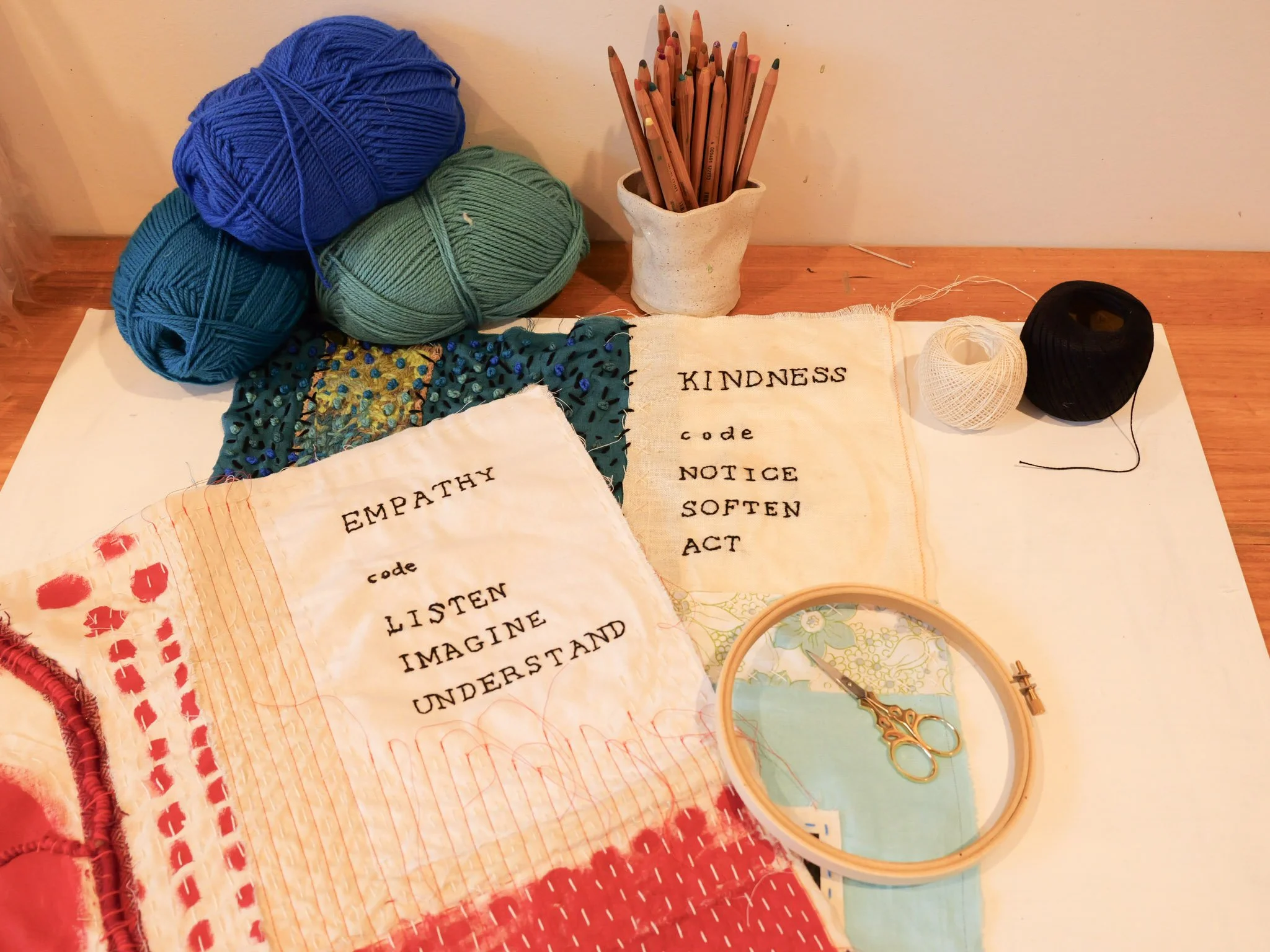
The Manifesto of Kindness Update
On Kindness, Creatures, and What We Choose to Keep Alive
There is a quiet thread running through my work at the moment—one that has been forming slowly, almost without announcement. It began as an instinct more than an idea. A noticing. A feeling that something essential is thinning in the world around us.
Kindness.
Not as a grand gesture, but as a daily practice. A way of seeing, responding, and holding one another. Increasingly, it feels fragile. As though it is slipping from our shared language. As though care, attention, and gentleness are becoming harder to locate, harder to sustain.
This body of work begins from that premise: that kindness, or what we might call goodness, is becoming an endangered quality.
On Kindness, Creatures, and What We Choose to Keep Alive
There is a quiet thread running through my work at the moment—one that has been forming slowly, almost without announcement. It began as an instinct more than an idea. A noticing. A feeling that something essential is thinning in the world around us. We all know what I’m talking about, you can see it on every social thread and it’s about the only thing we hear about on the news. Madness and hatred seems to be taking over.
But this project is about something else. Something far more important and powerful.
Kindness.
Not as a grand gesture, but as a daily practice. A way of seeing, responding, and holding one another. Increasingly, it feels fragile. As though it is slipping from our shared language. As though care, attention, and gentleness are becoming harder to locate, harder to sustain.
This body of work begins from that premise: that kindness, or what we might call goodness, is becoming an endangered quality. And we must fight for it’s preservation.
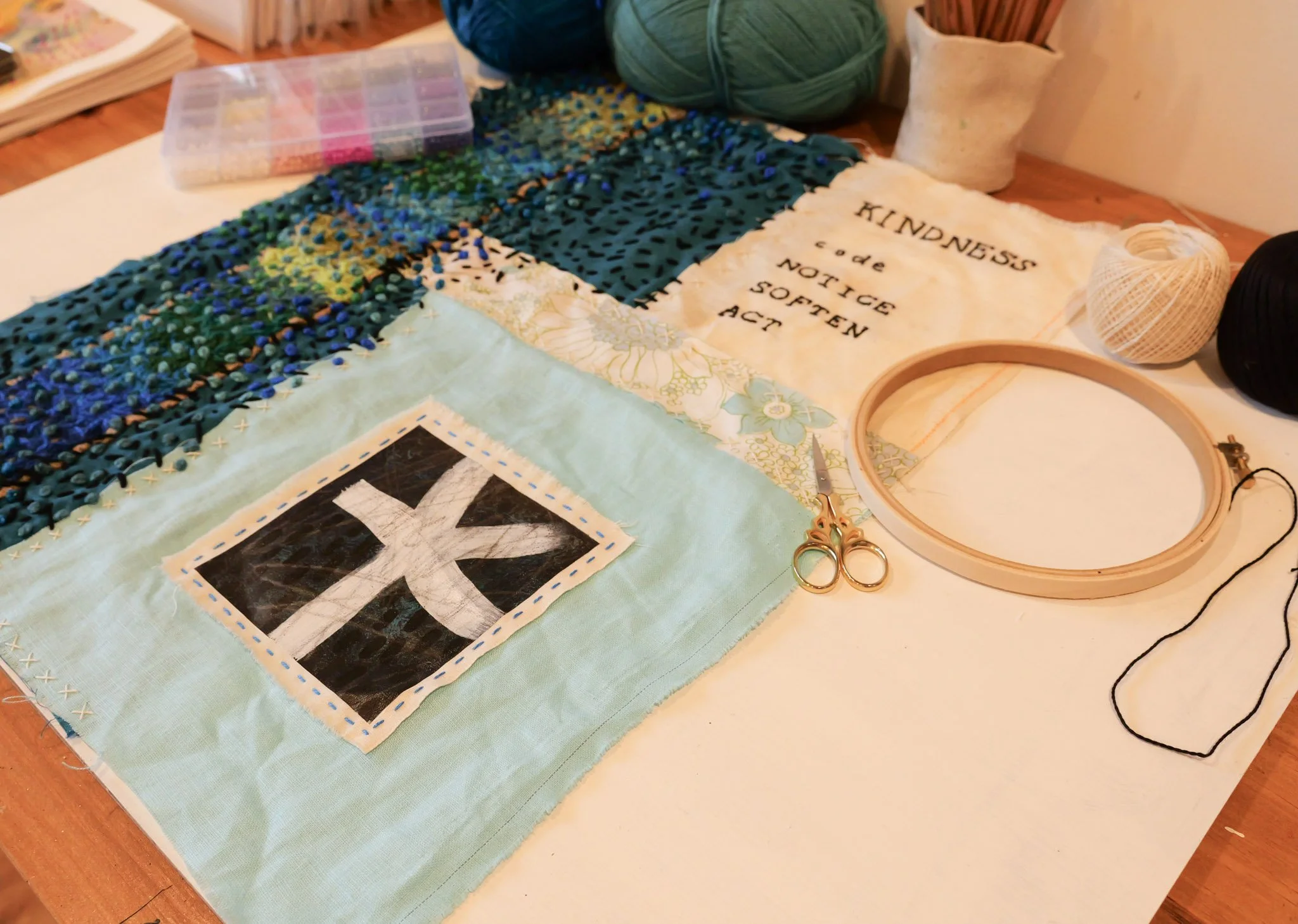
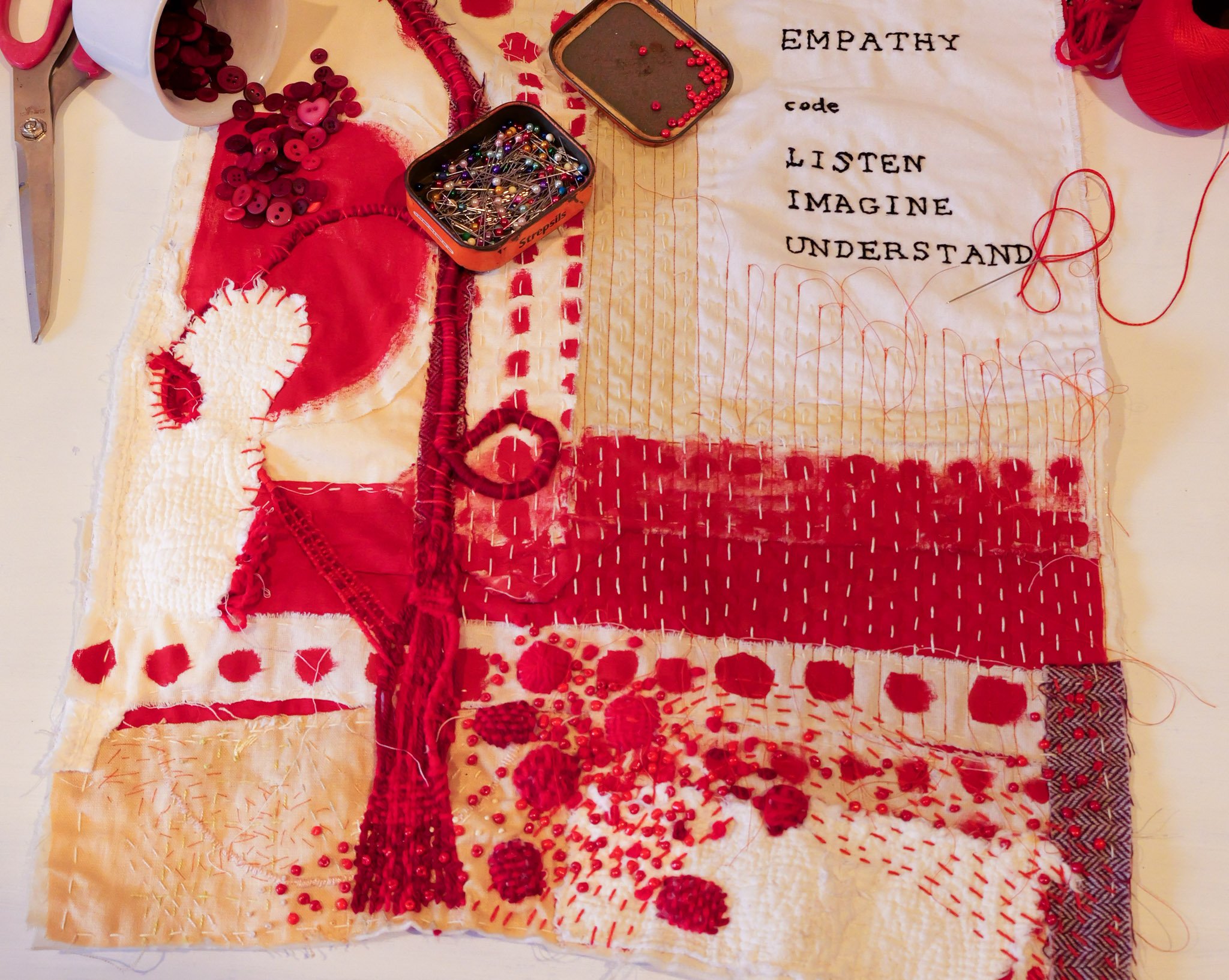
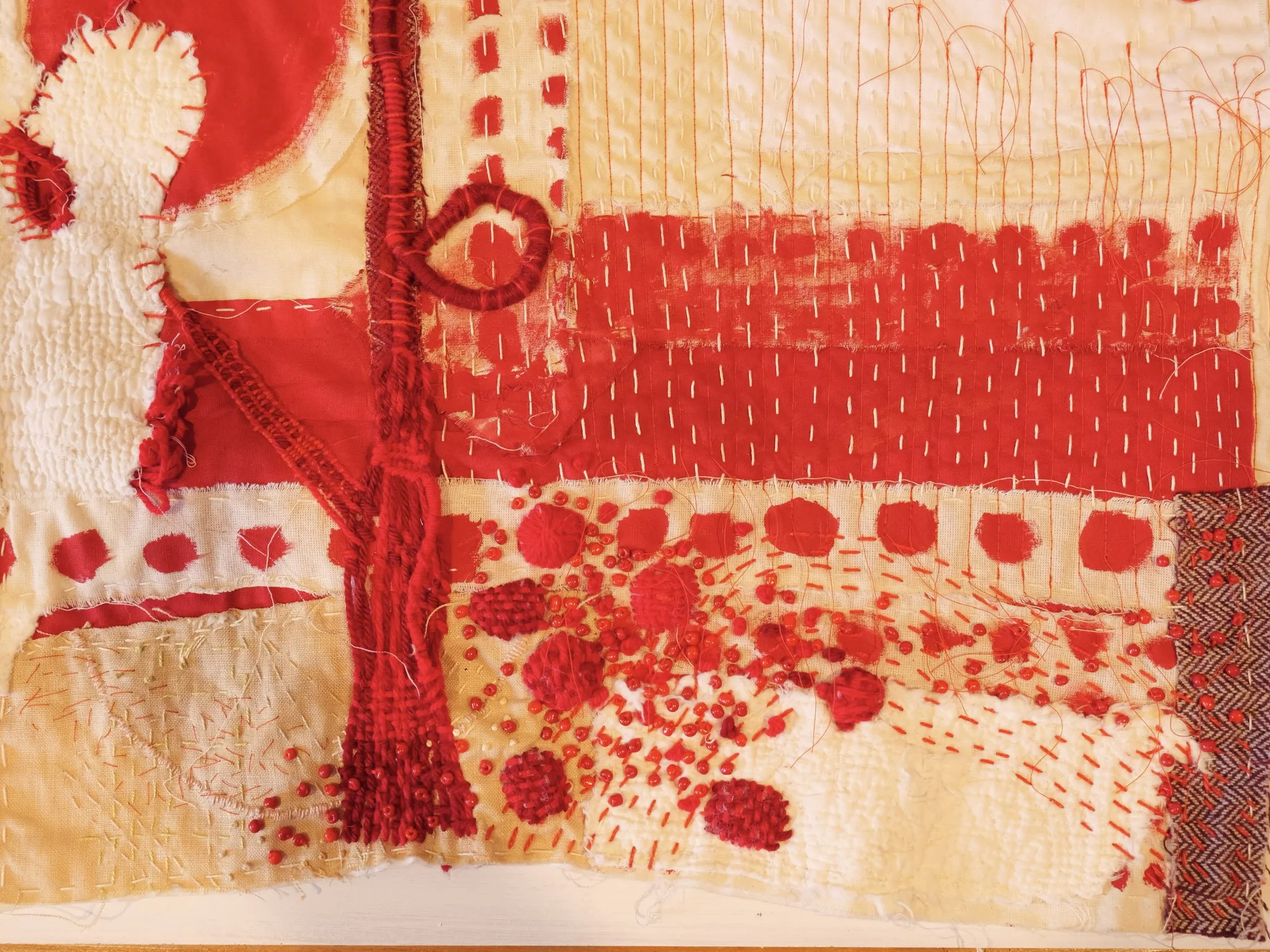
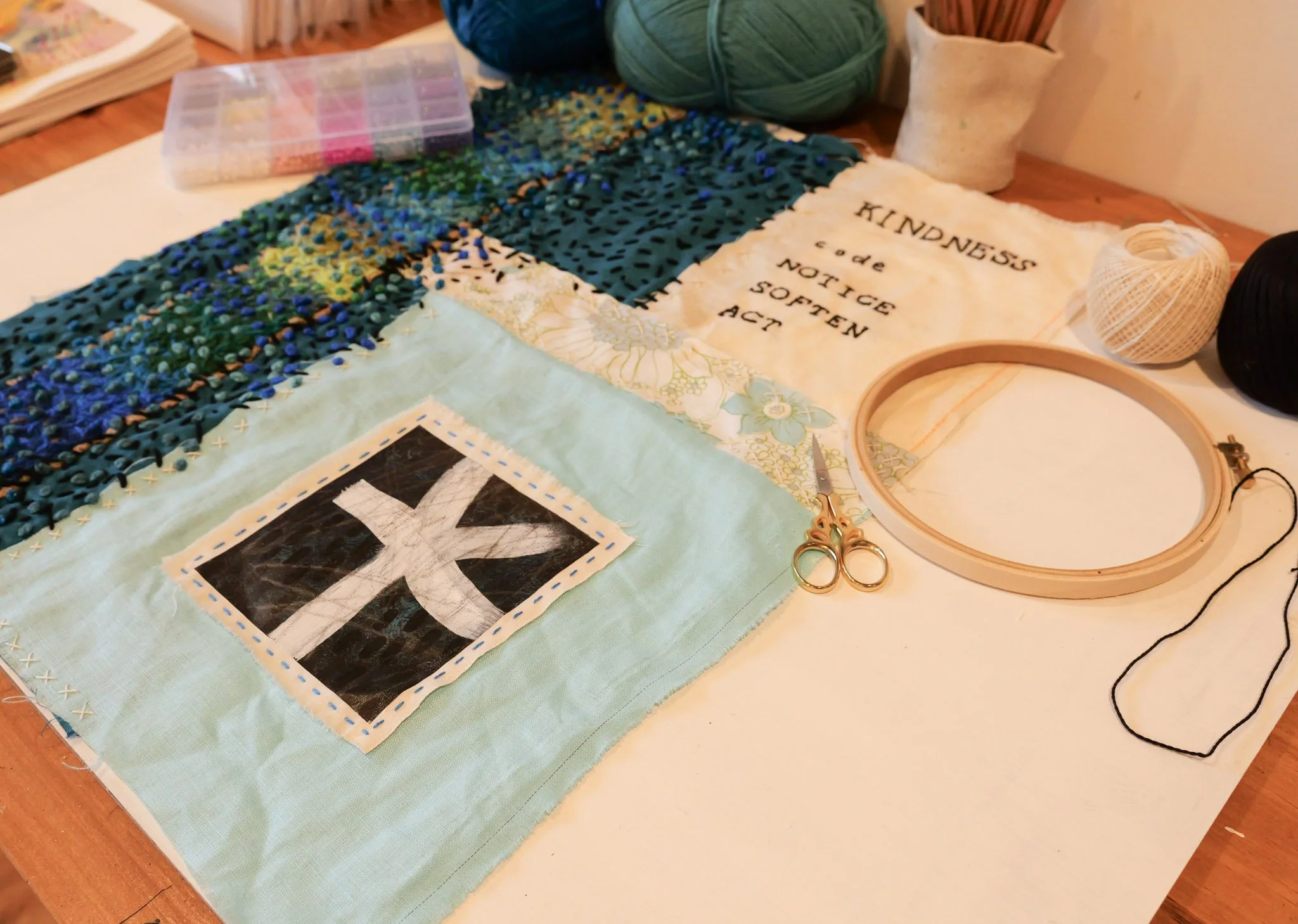
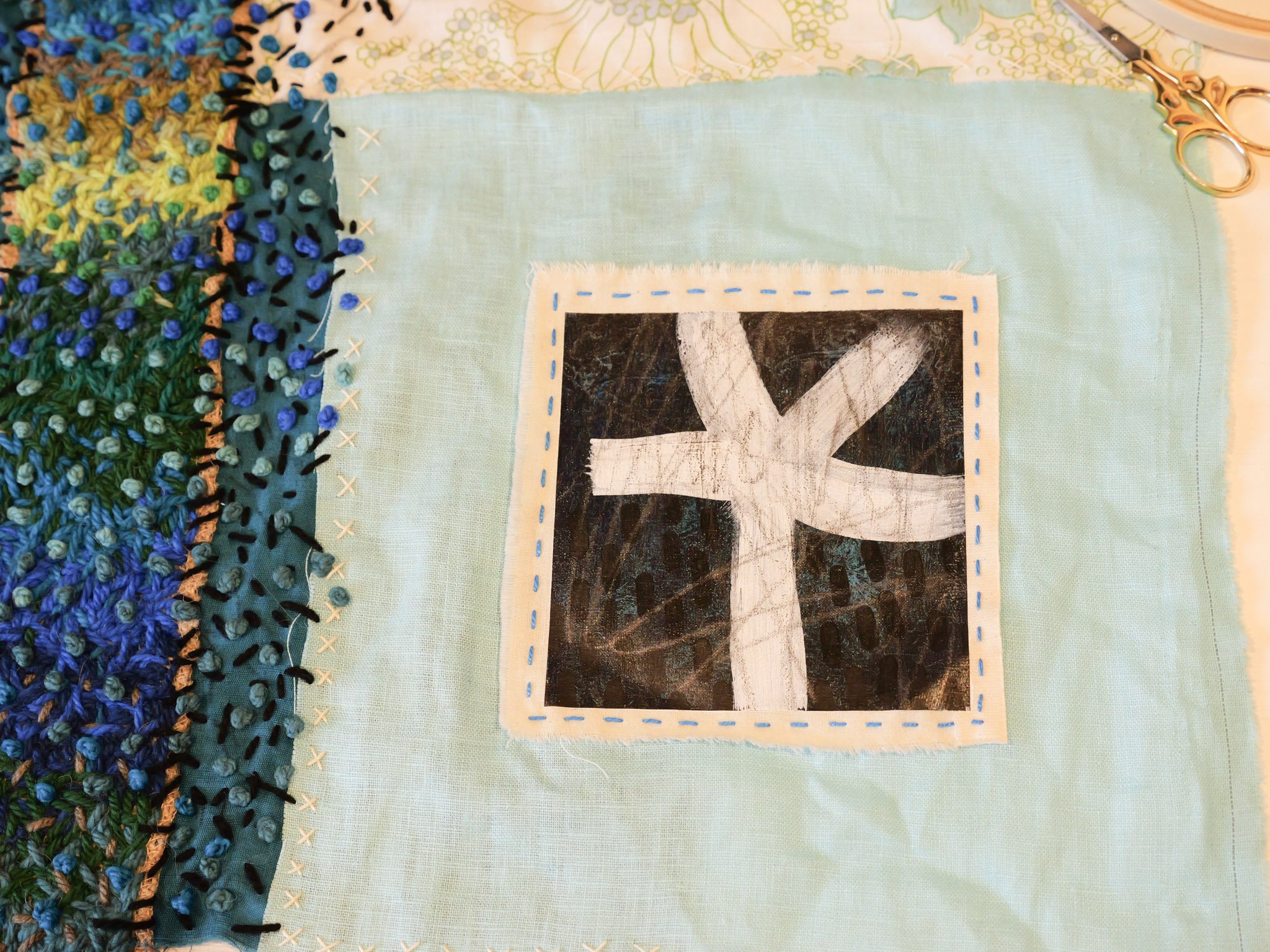
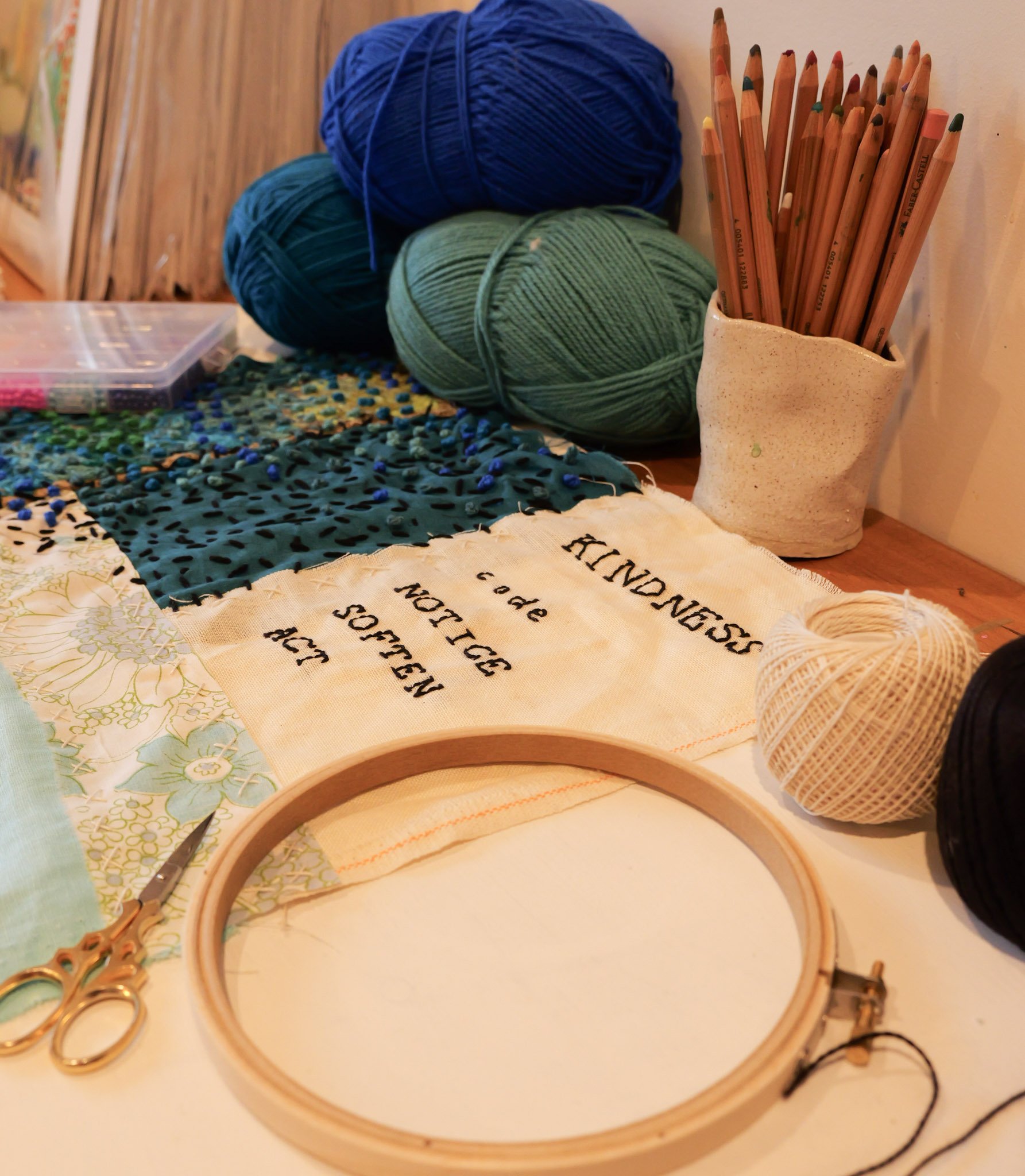
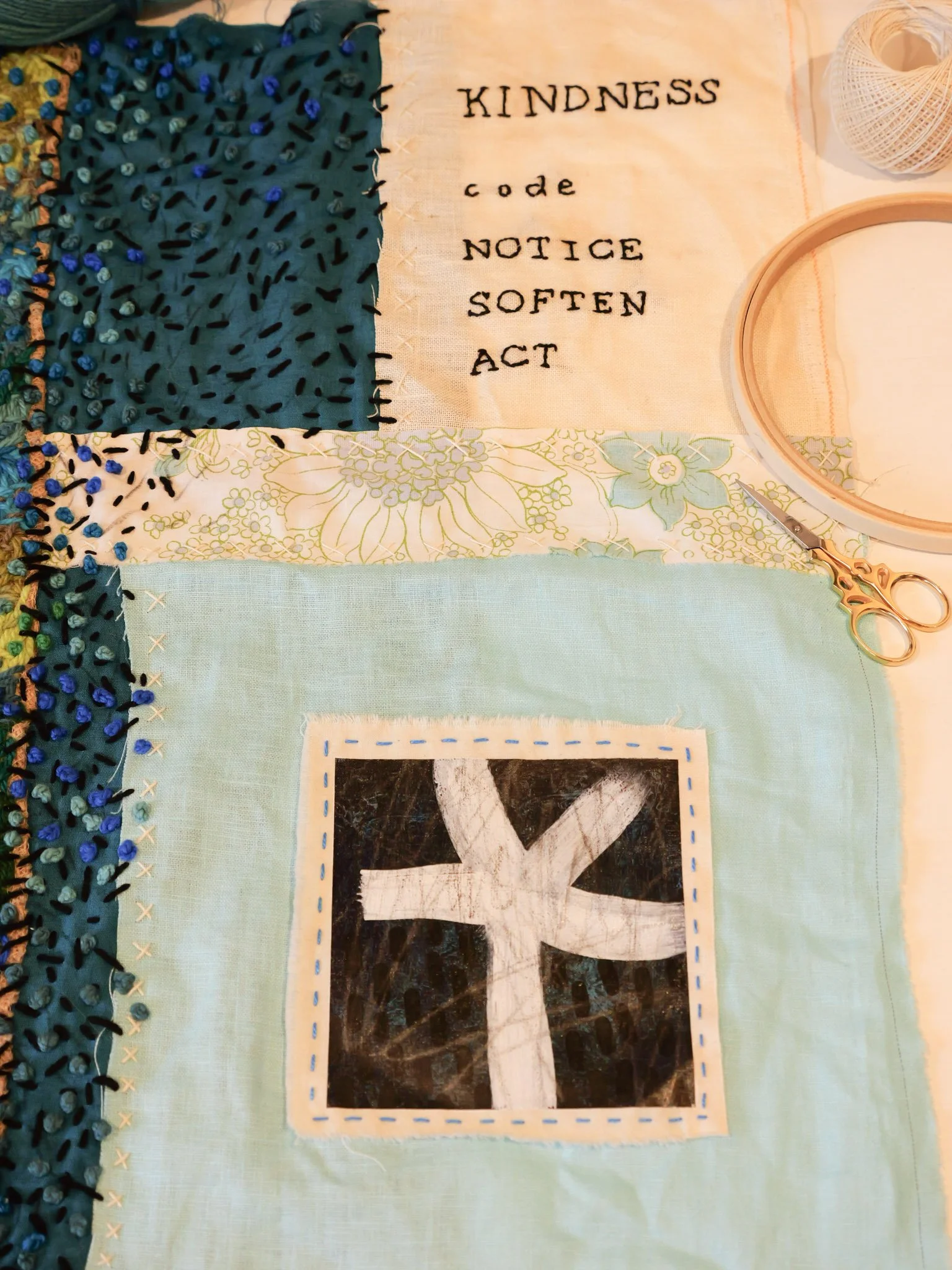
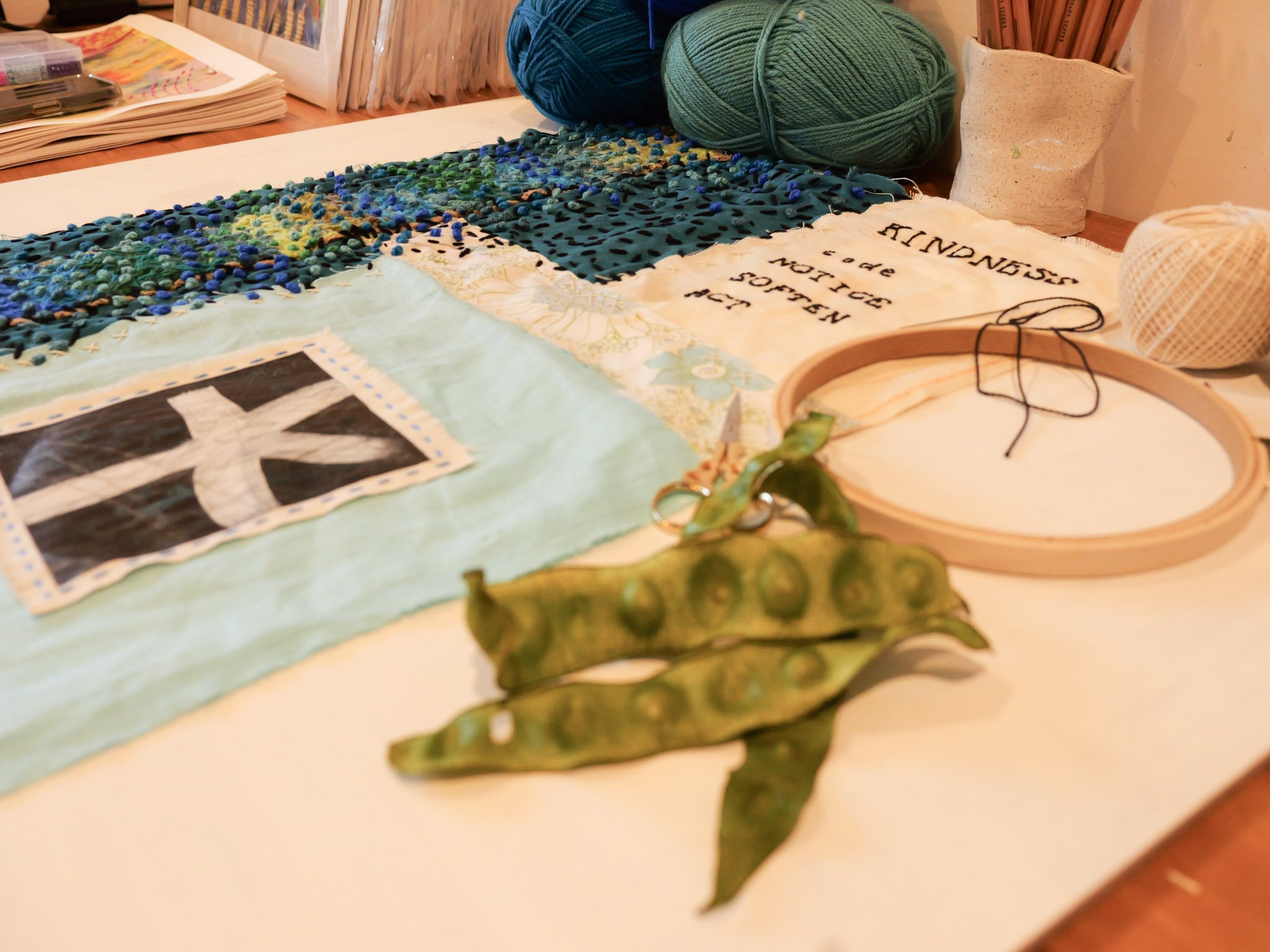
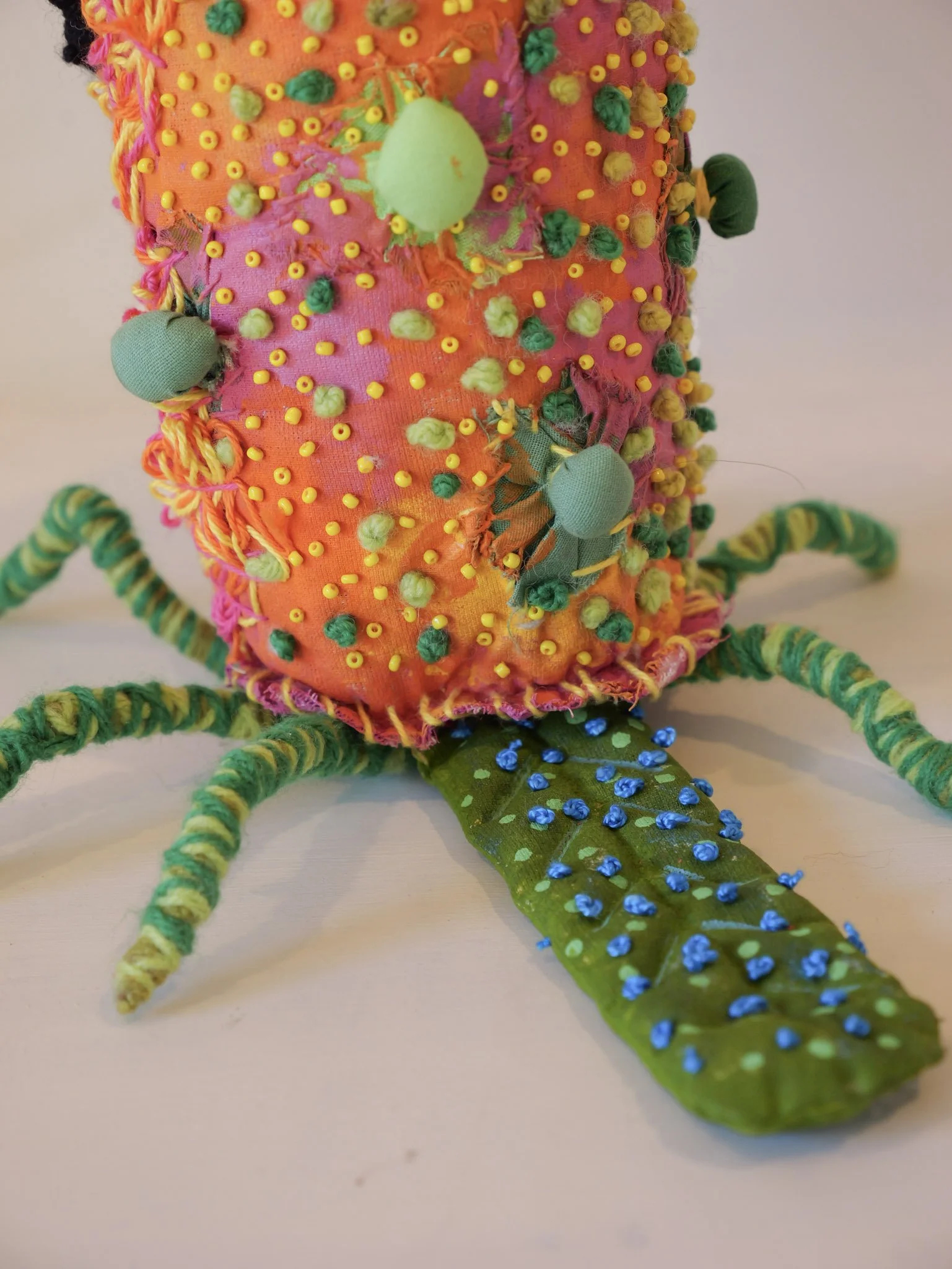
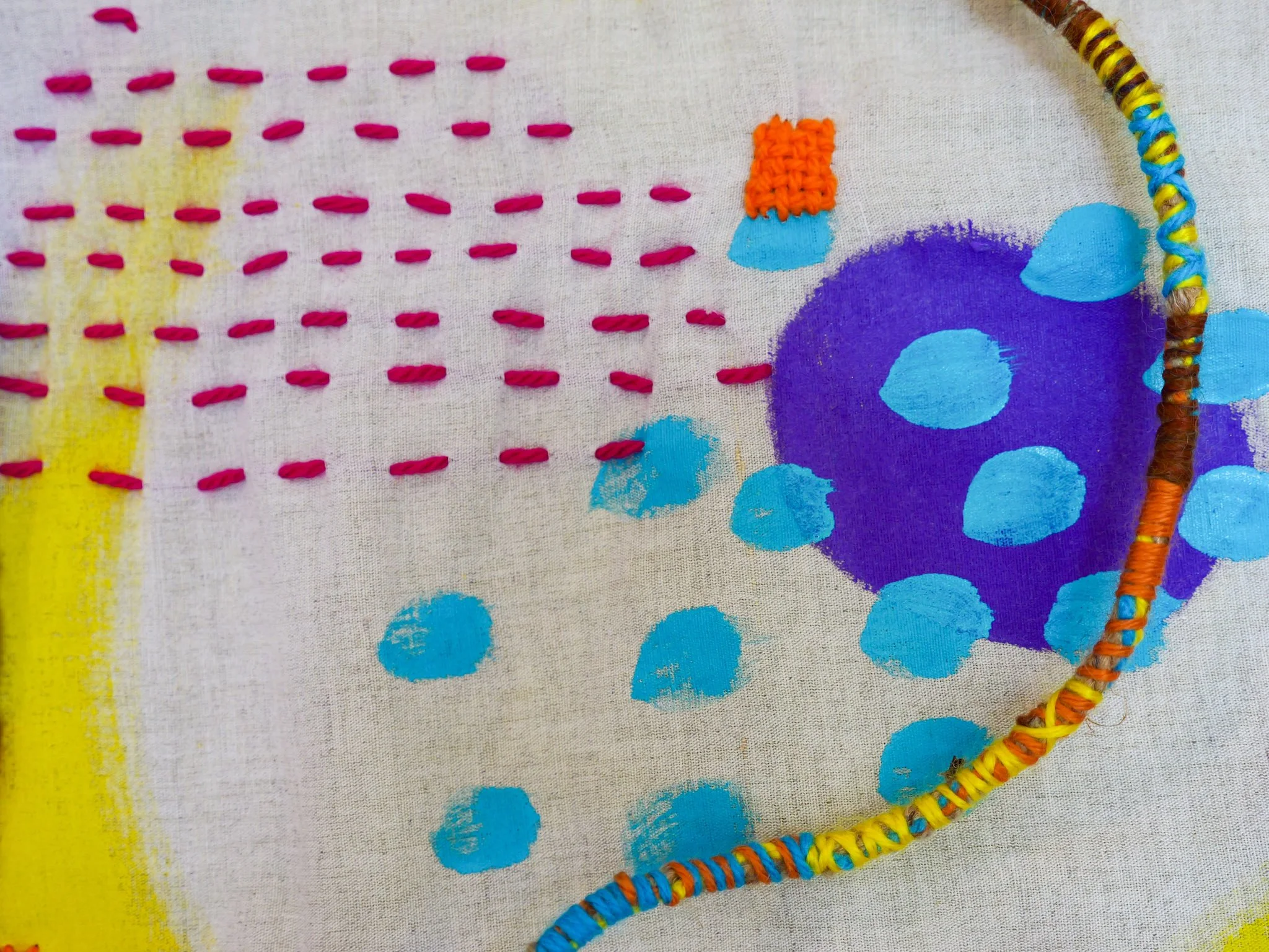
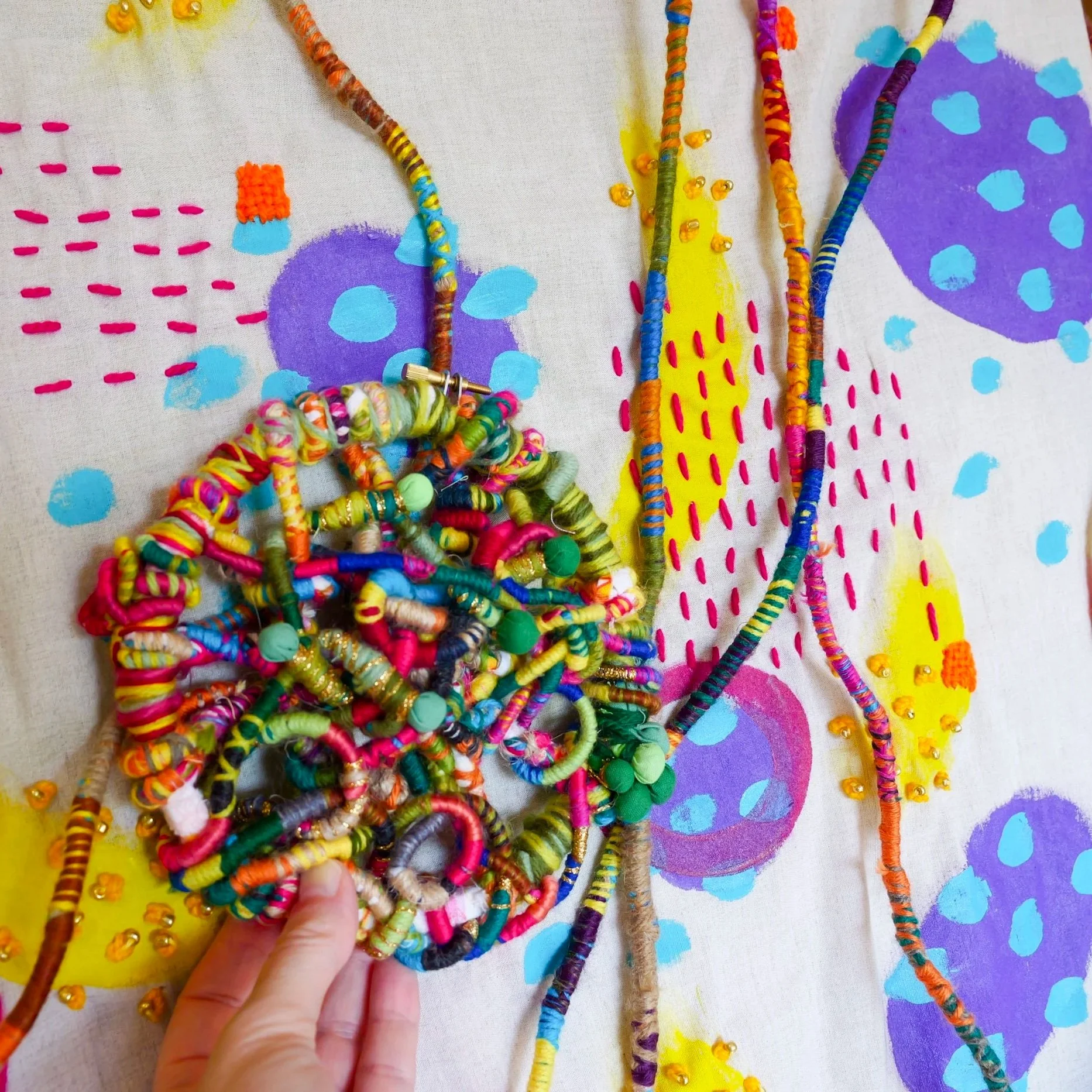
Detail of hand painted linen fabric with embroidery sections.
The Creatures
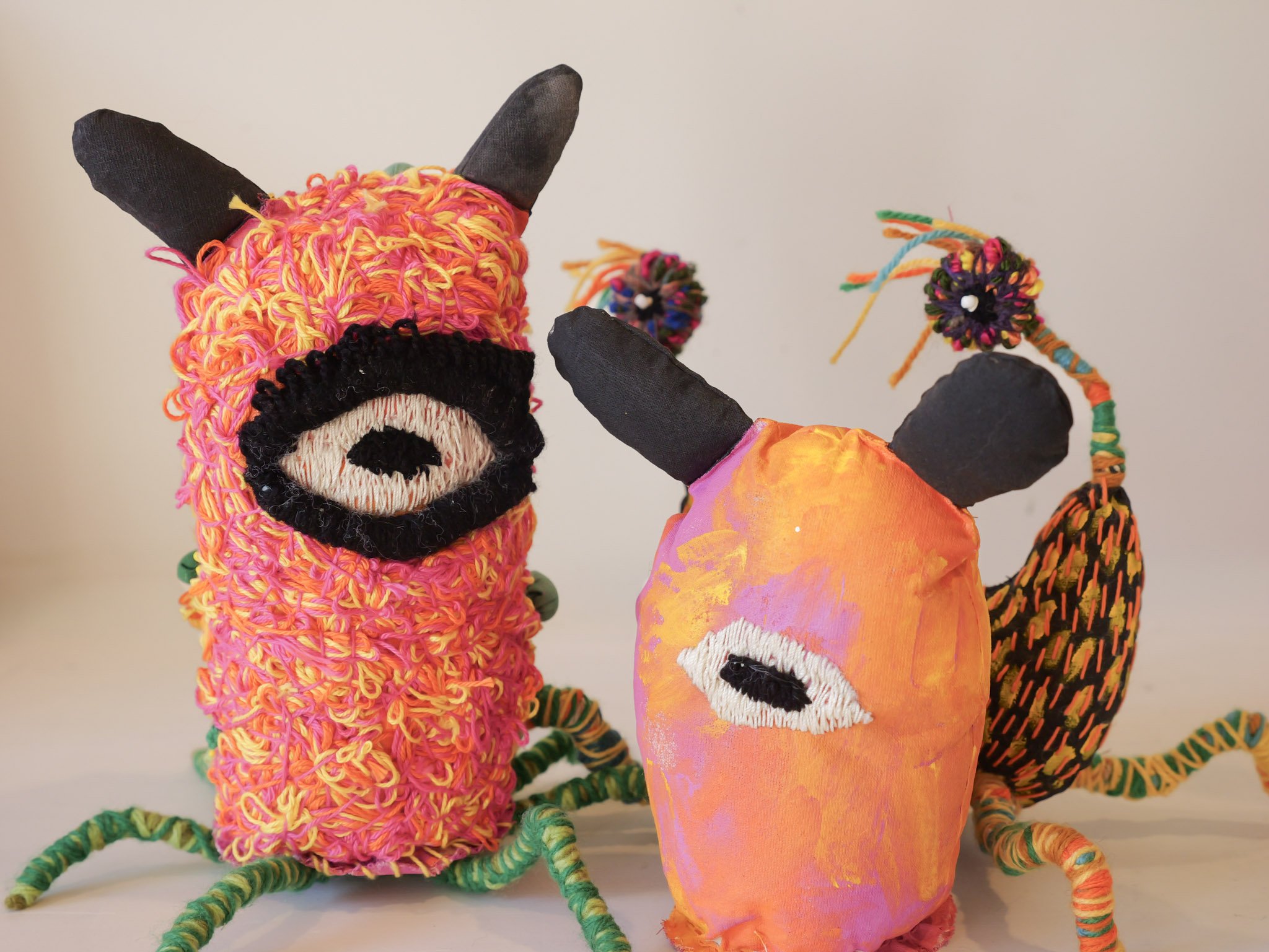
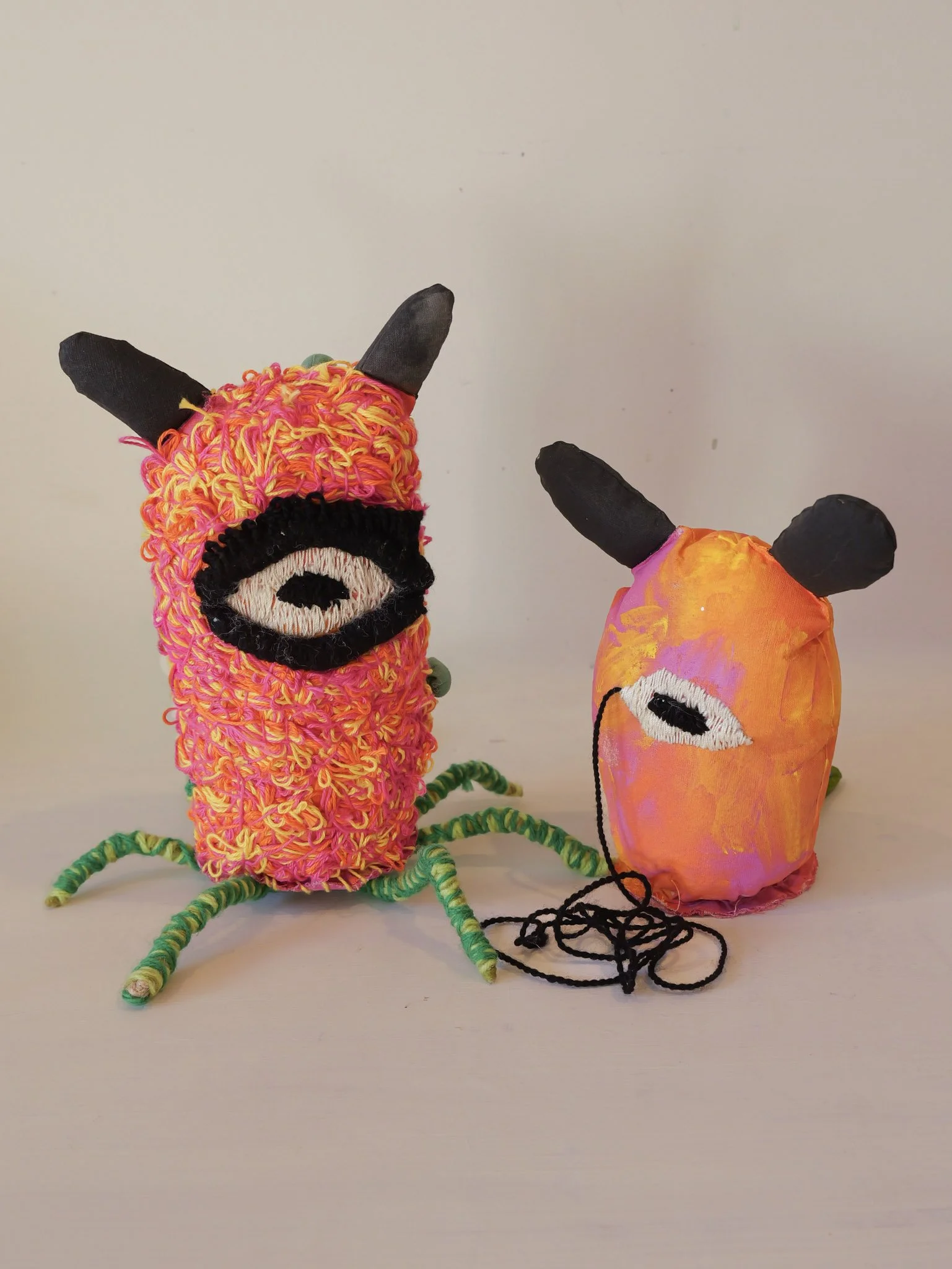
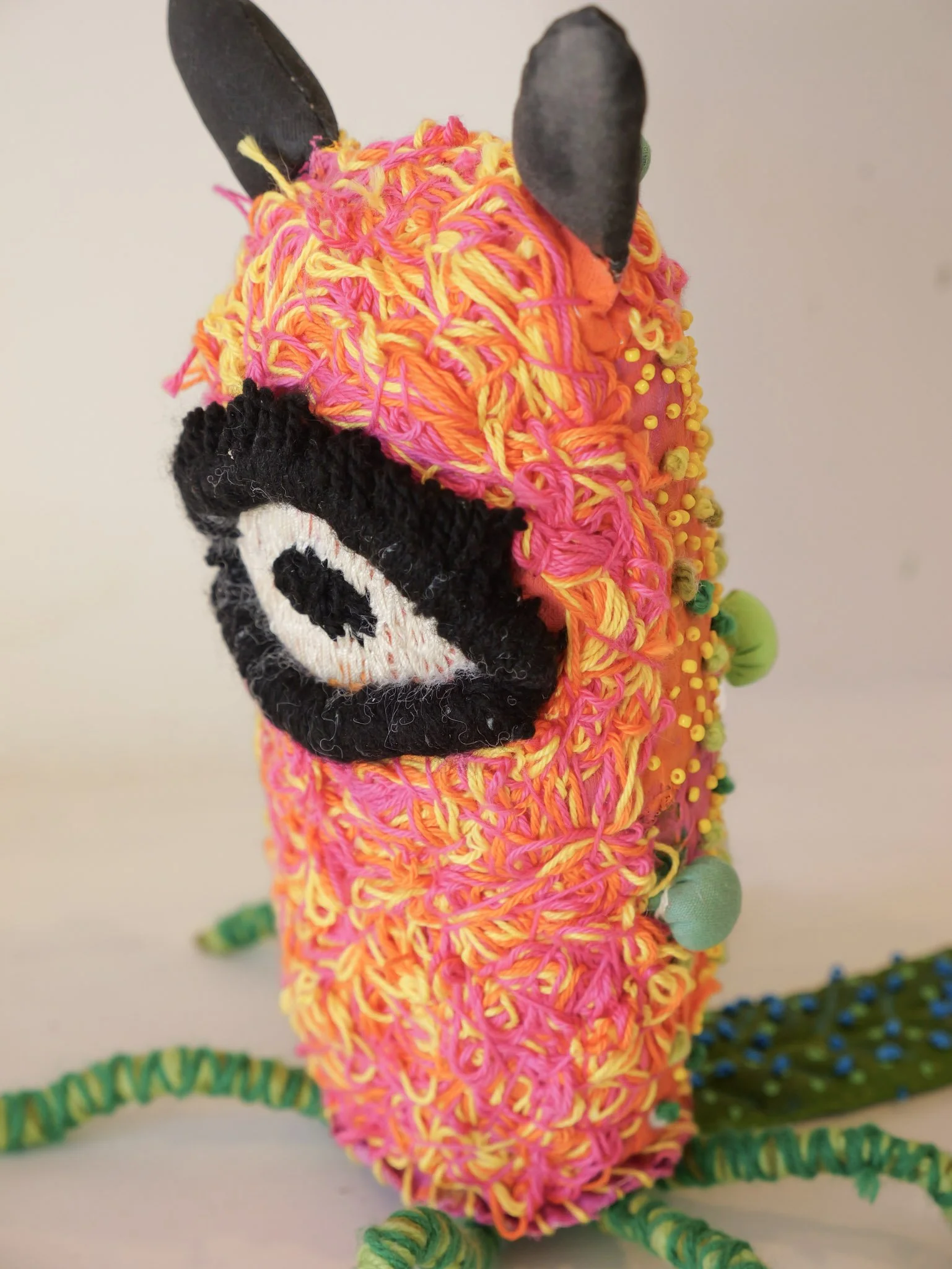
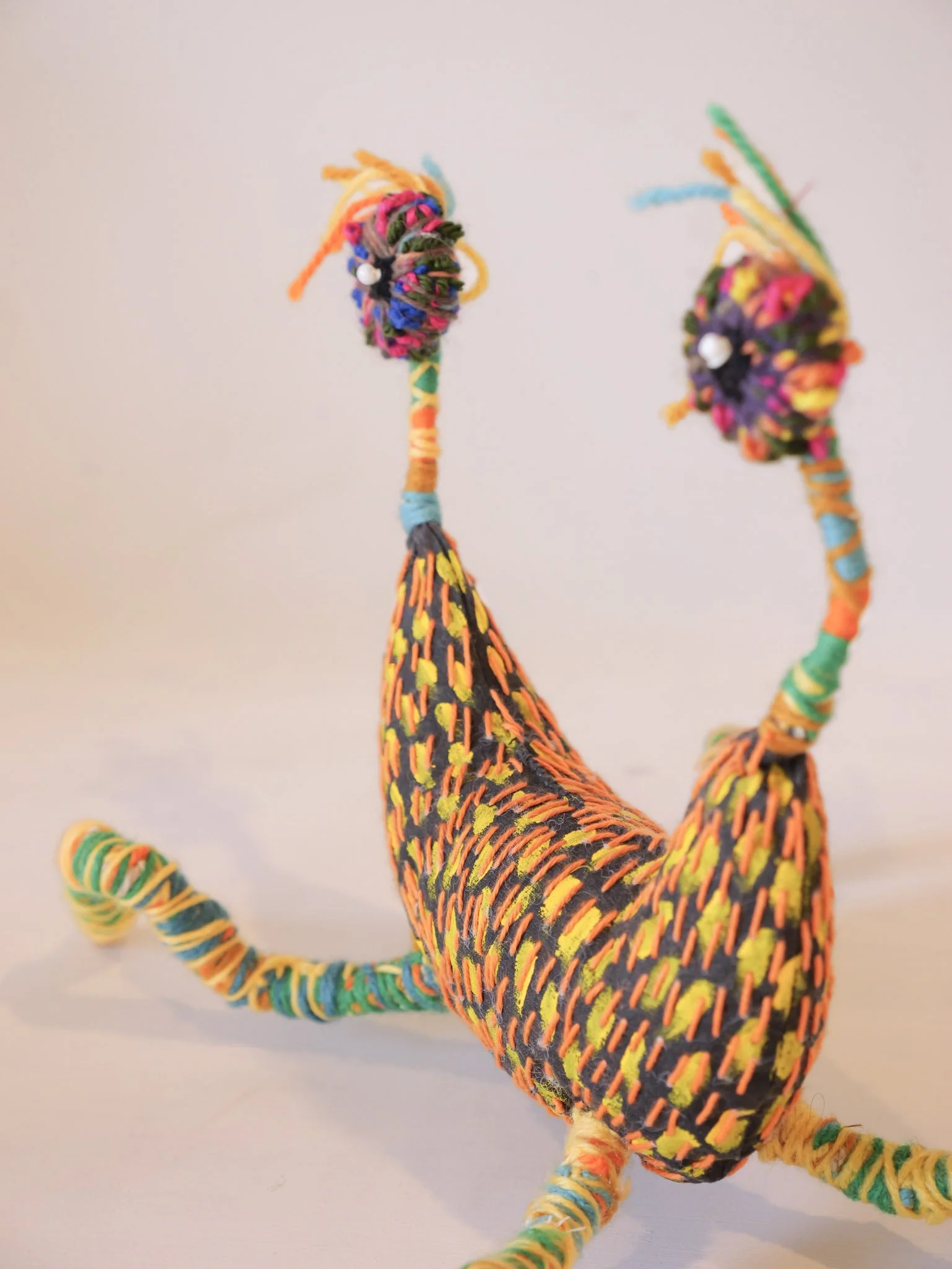
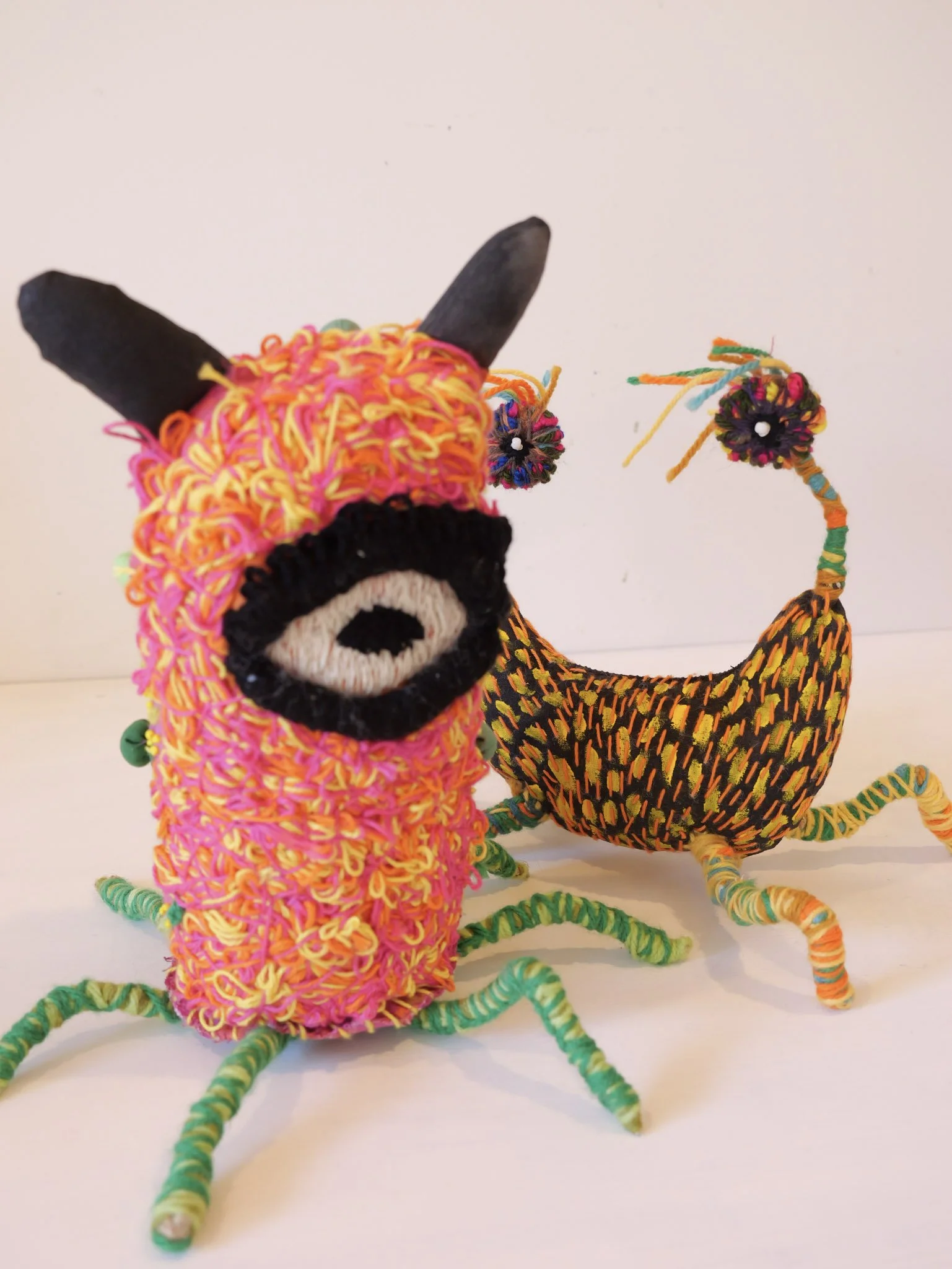
Alongside this idea of kindness, a small group of creatures have continued to emerge.
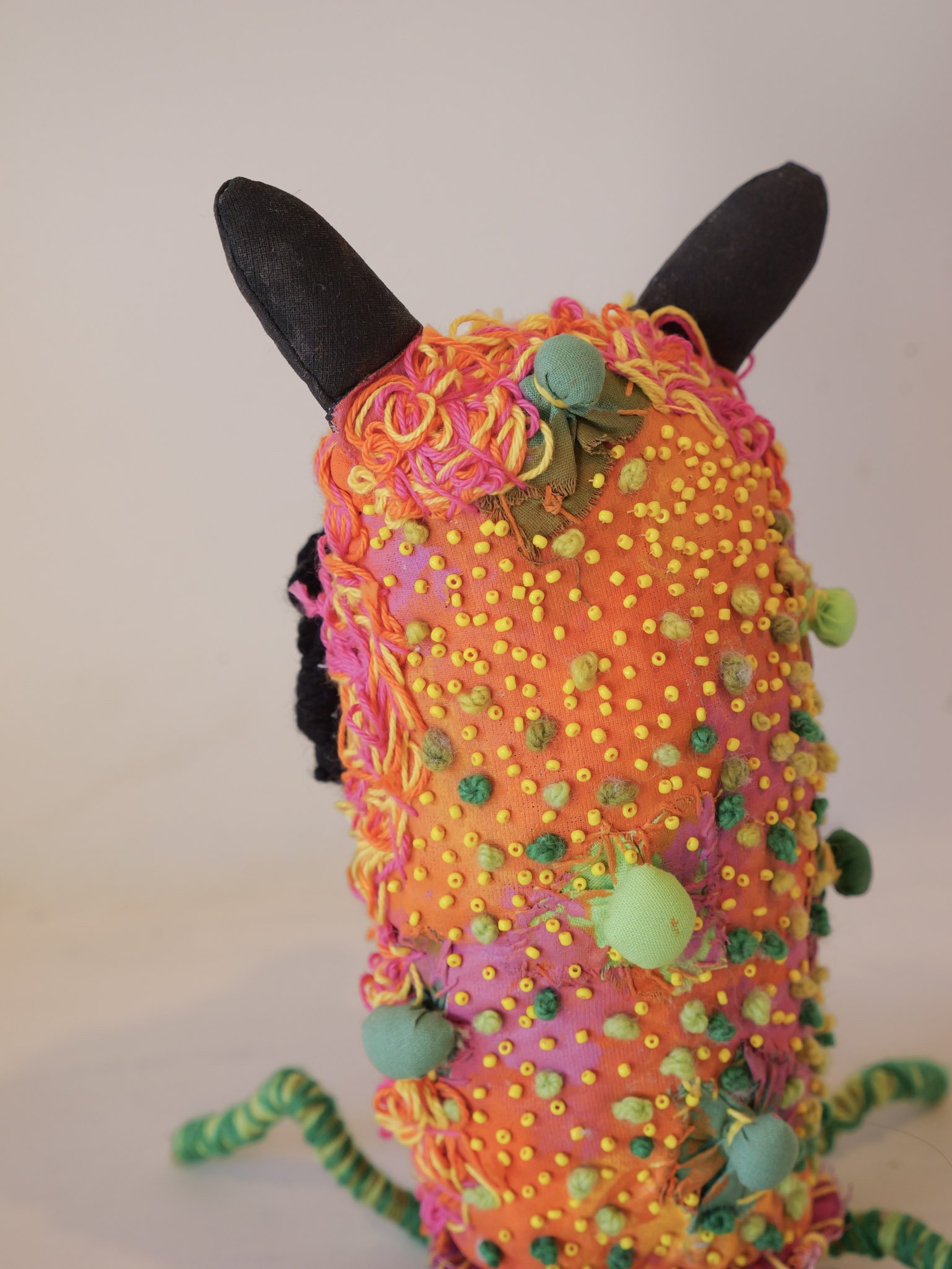
They are not fixed beings, but evolving forms—stitched, painted, assembled. Each one carries a quiet presence. They are soft, attentive, often watchful. They do not dominate space; they hold it.
I’ve been thinking of them as keepers of kindness.
They embody qualities that feel increasingly rare: patience, care, curiosity, gentleness. They exist without hierarchy. They do not compete. They simply are present with one another, responsive, and connected.
In many ways, they act as a counterpoint to the world we are building. Not as fantasy or escape, but as a proposition:
What if the qualities of kindness are grounded again?
What if care was not secondary, but foundational?
The creatures offer no answers. But they offer possibility.
I don’t create these creatures with a preplanned sketch or design. They evolve in the studio, in the moment. Often I am interested in a certain mode of textile art; weaving, embroidery, and I simply let the form create the shape of the creature. This way, I am not attached to the aesthetics of the creature.
I’ve had a lot of fun with the 3 I’ve created so far and I hope that one day I will have a heaps of them: imagine a gallery floor filed with hundreds of them. Together we might need to come up with a collective noun for them; something that denotes kindness and togetherness.
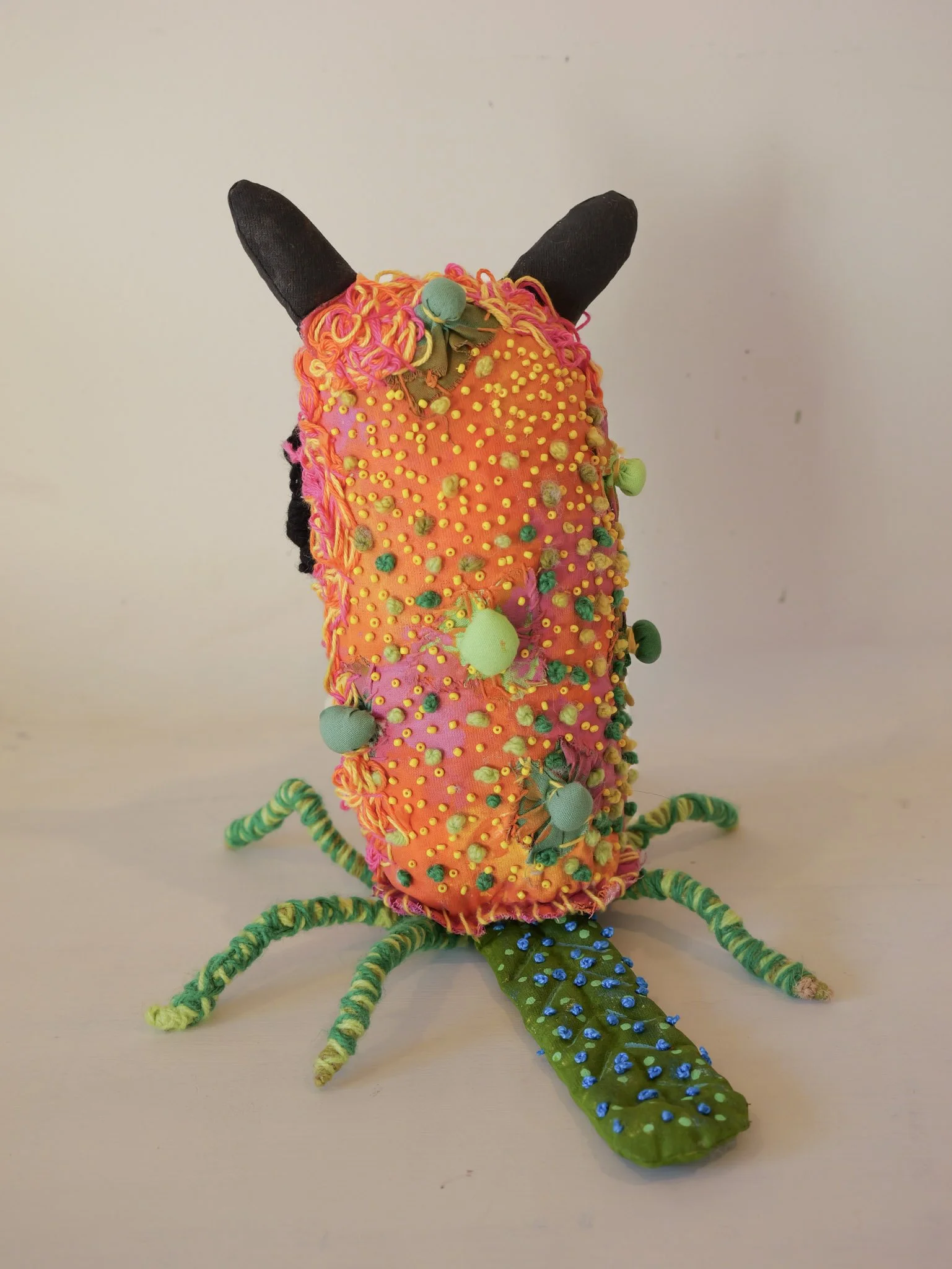
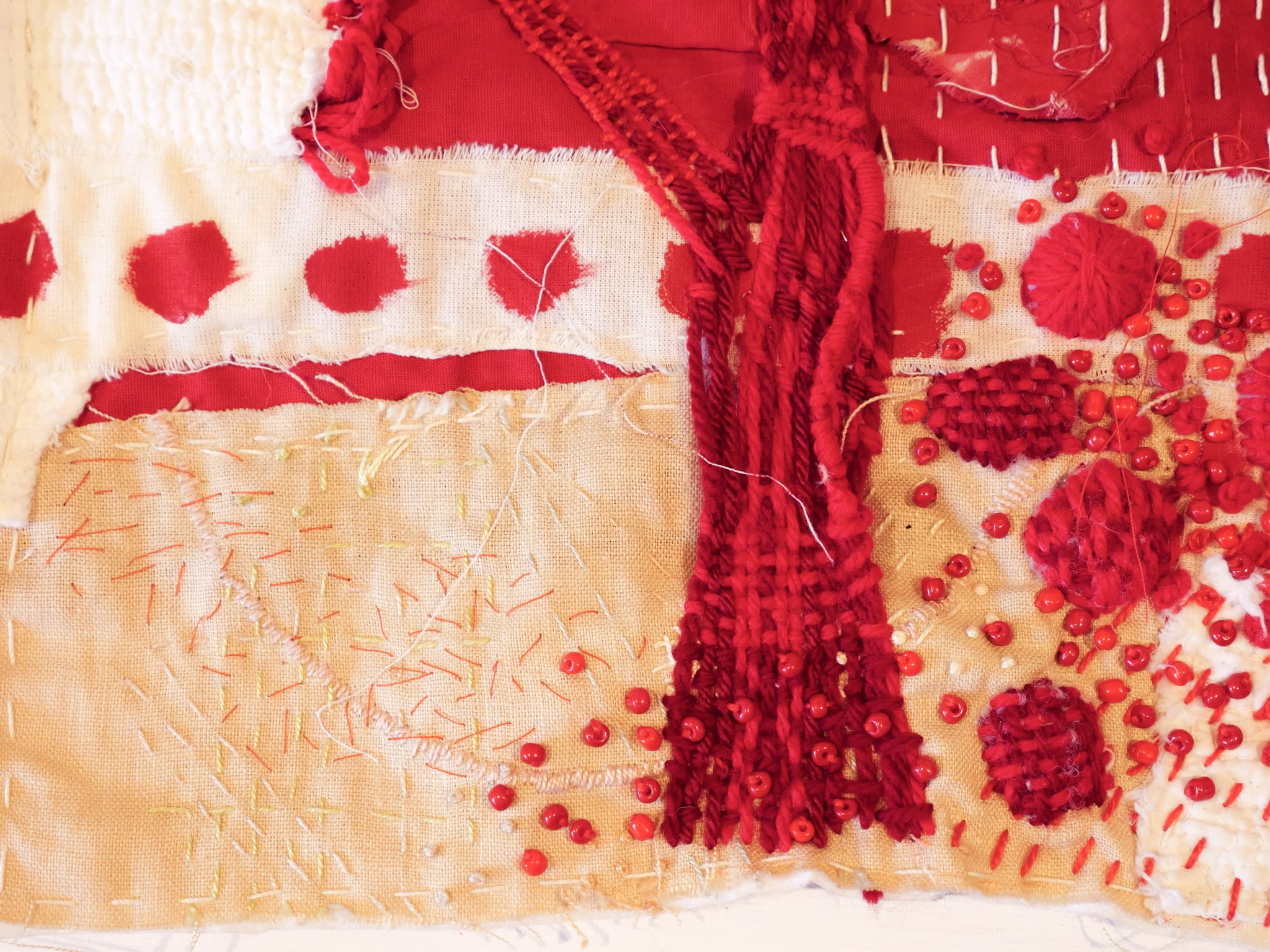
Detail of bead work application on the back of one of the creatures.
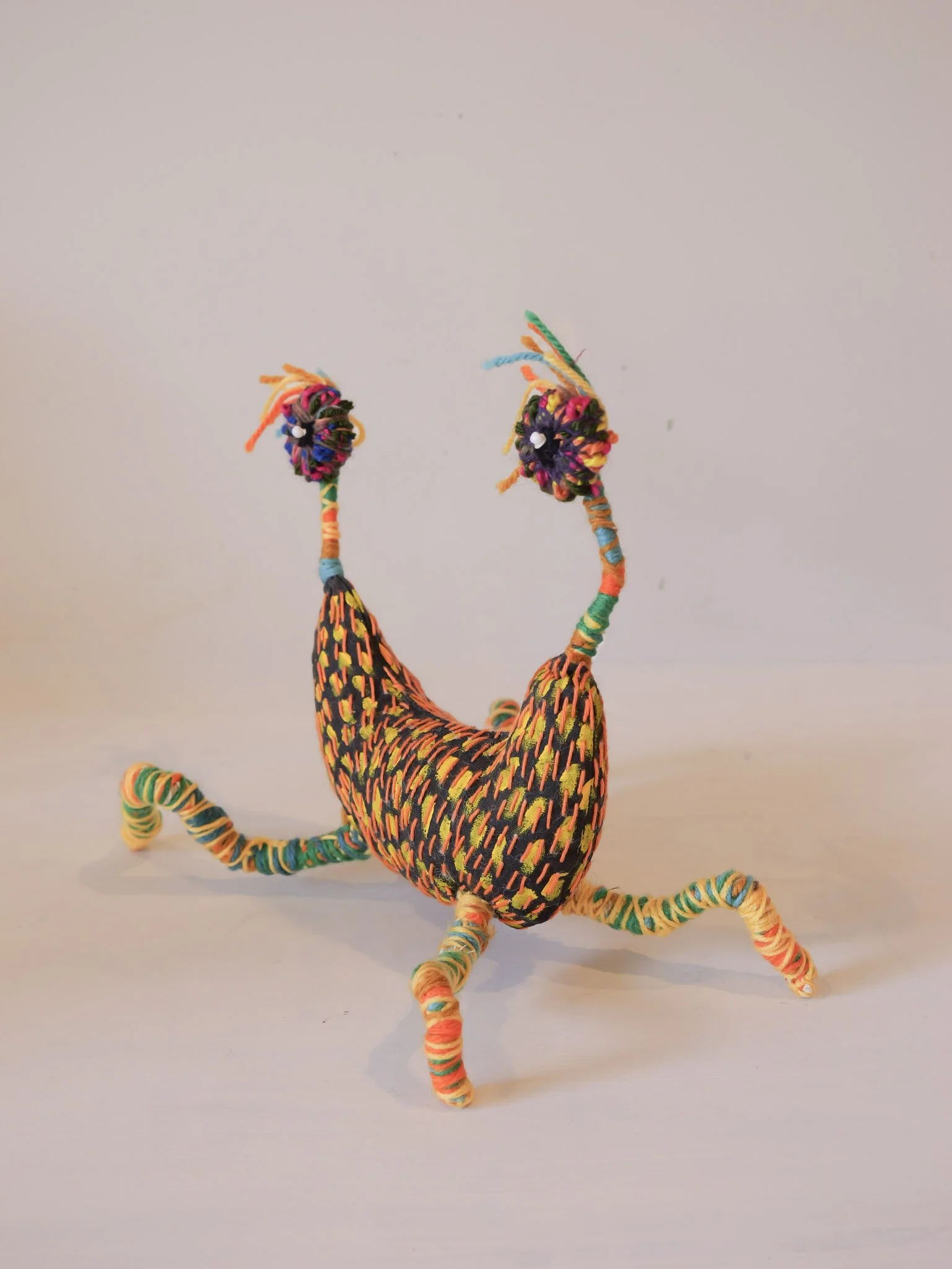
The first creature ever created.
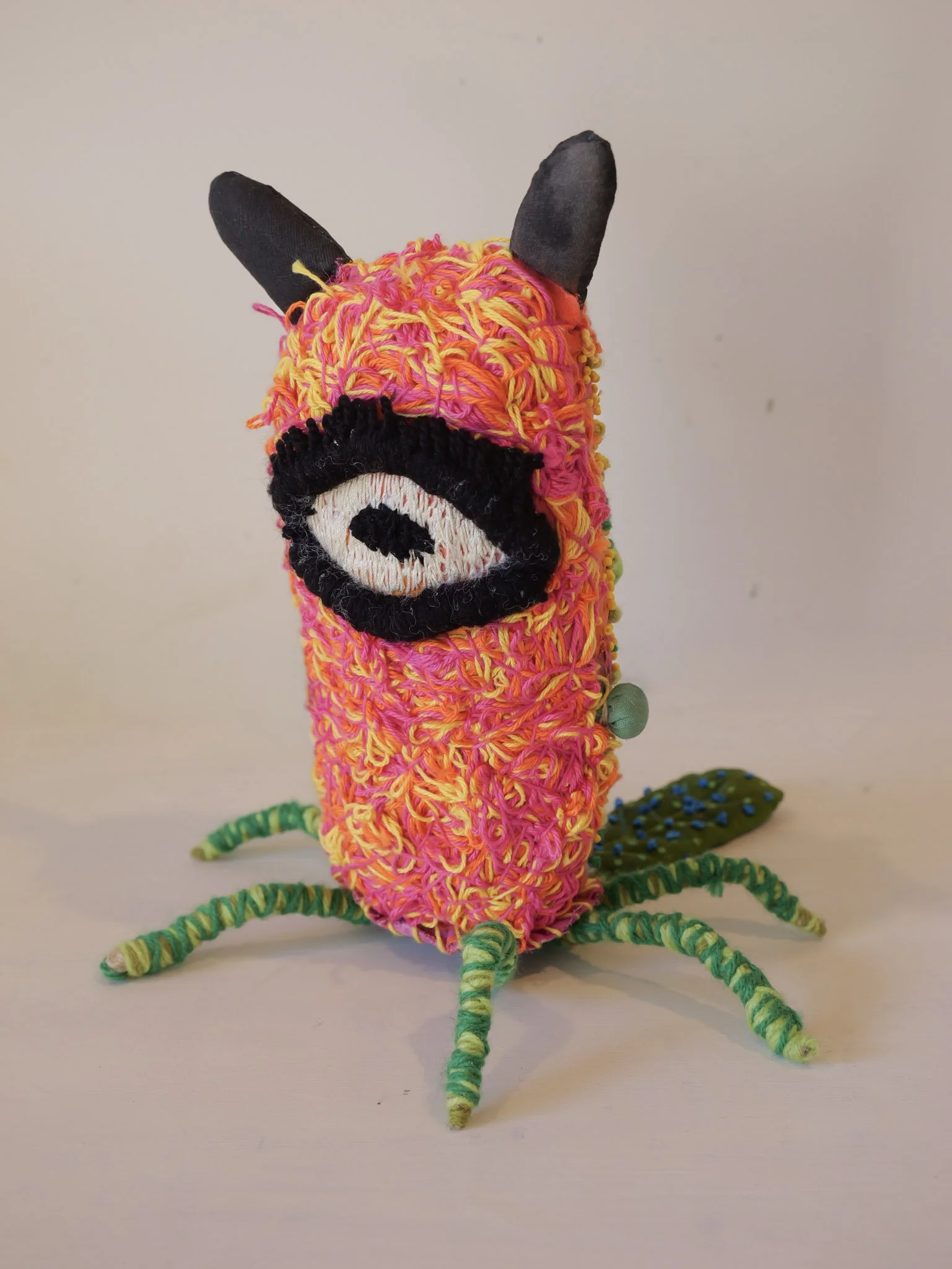
Close up of one of the first creatures created.
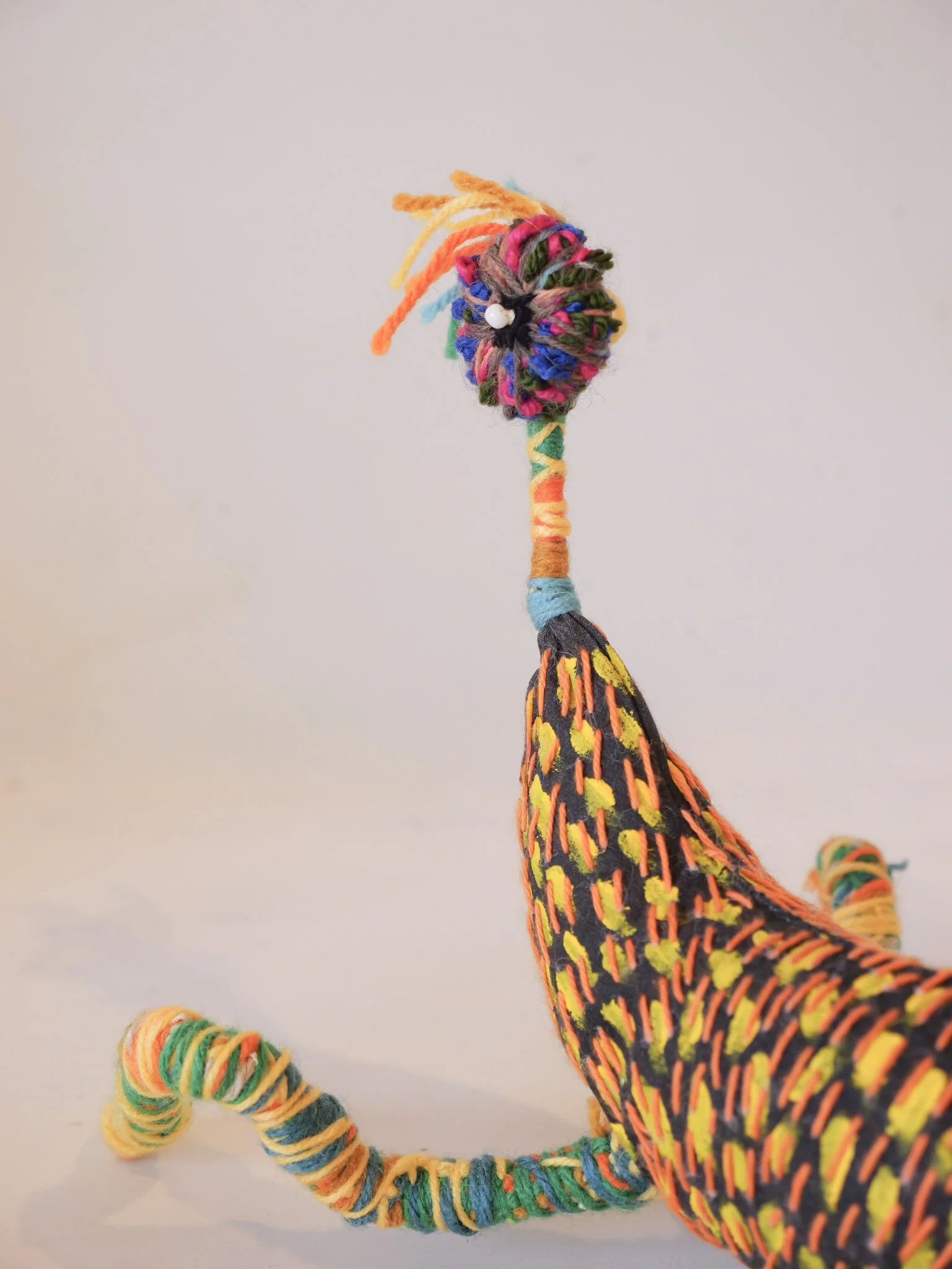
Close up of eye and body detail.
The Twelve Panels
Running alongside the creatures is a new series of twelve textile panels.
Each panel focuses on a single quality that supports kindness:
Kindness
Empathy
Compassion
Humility
Patience
Generosity
Justice
Courage
Respect
Responsibility
Curiosity
Solidarity
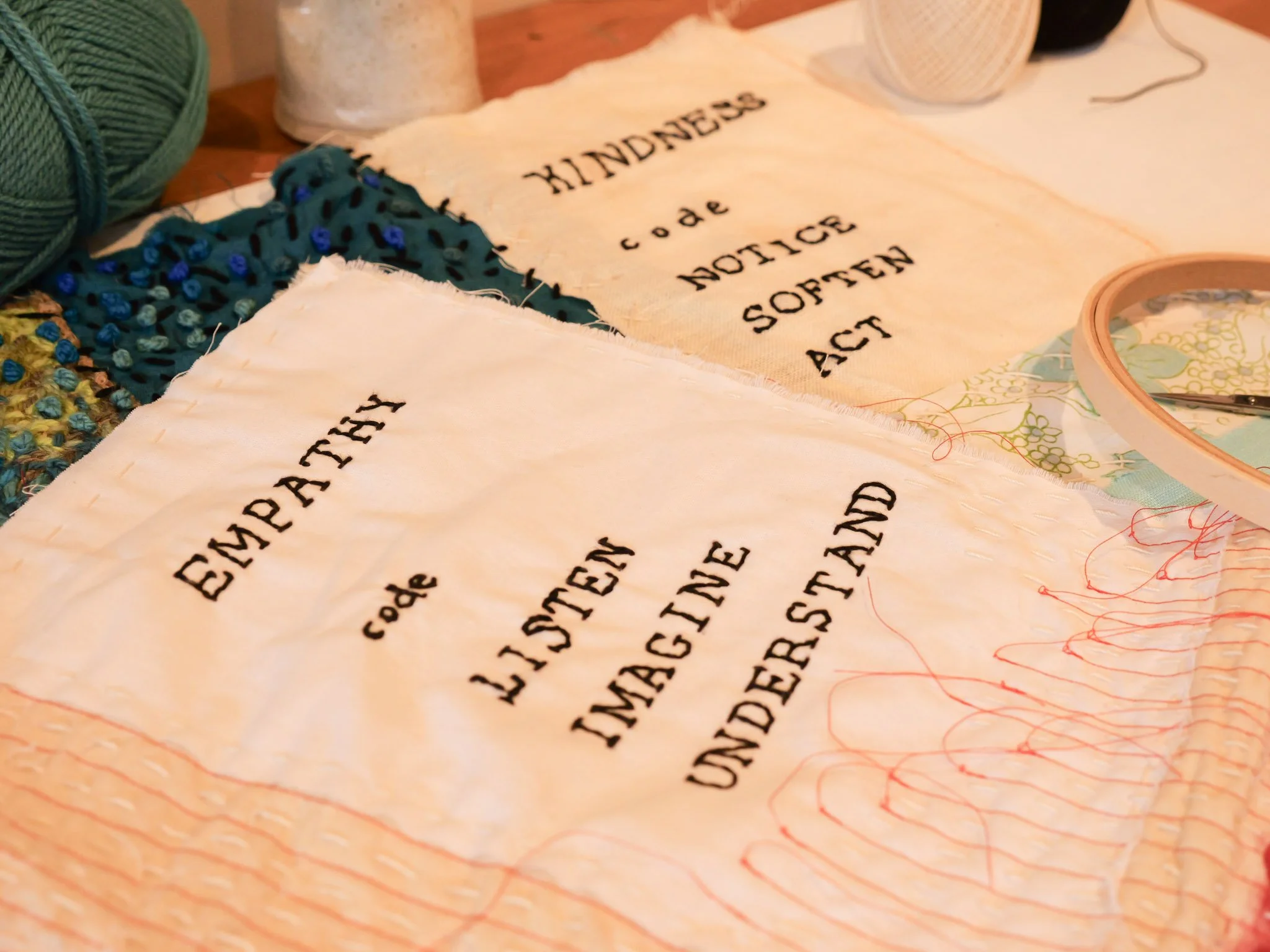
Together, they form a kind of stitched manifesto—a set of quiet instructions for how we might live alongside one another.
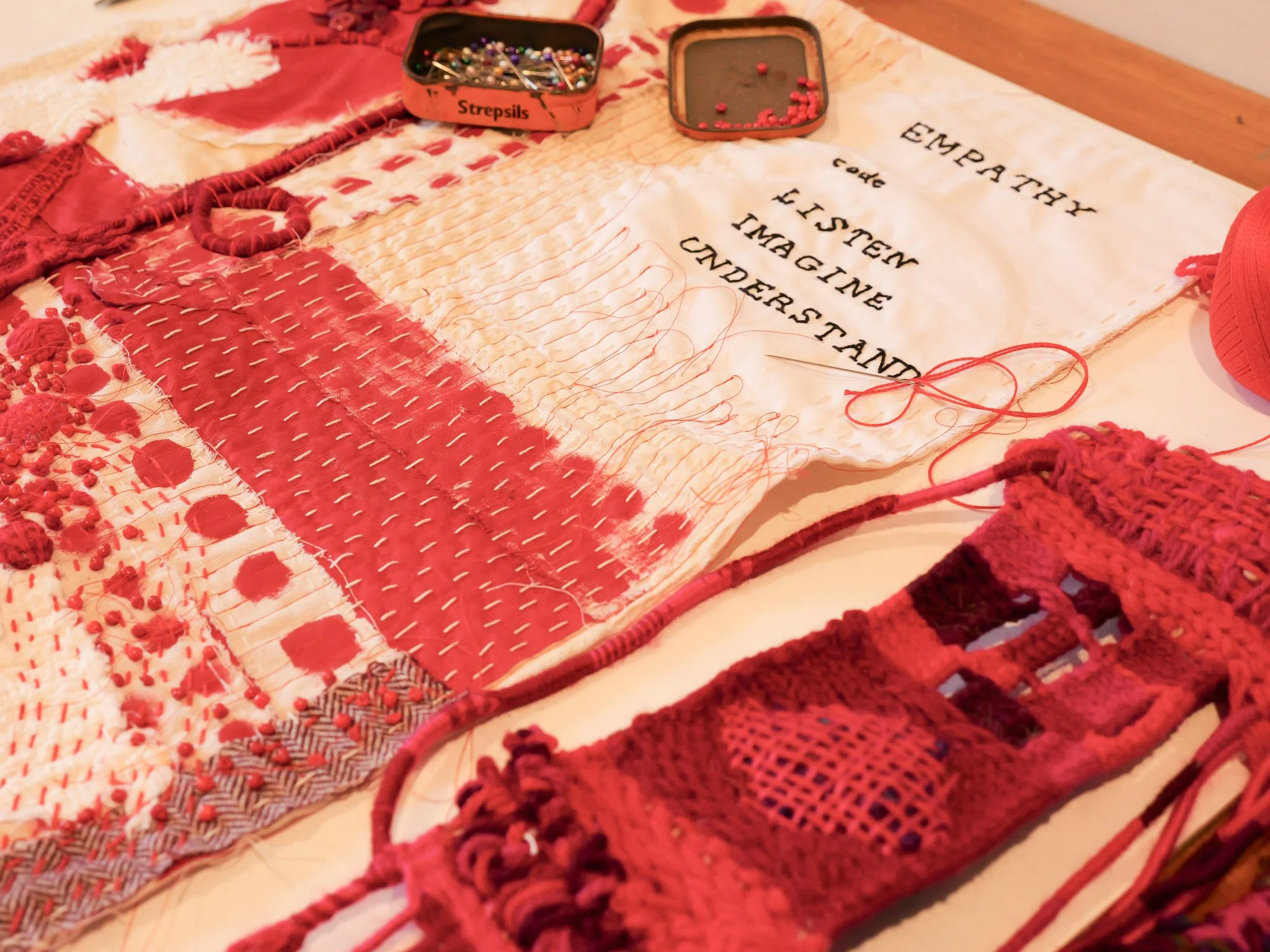
Each piece includes hand-stitched text, pared back to its simplest form. Language is reduced to small directives. It is a code system and is informed / inspired by sewing patterns and instructions.
The intention is not to overwhelm, but to offer something clear, almost instinctive. Something that we can returned to as a source of guidance to live by.
The panels are slow works. Built through layering, stitching, pinning, adjusting. Time is visible in them. Labour is visible. Care is embedded in their making. I sit for hours in the studio stitching away at these panels.
There is something important in using textiles to speak about kindness. Across the world, people they often say that fabric holds memory: linen, silk and wool. I’m preferring to work mostly on linen with wool thread at the moment.
The stitching is repetitive; I find it almost meditative. It requires presence. It cannot be rushed. It takes as long as it takes. There is no fast 3 second hook here.
Each panel like the creatures are evolving in the studio with no real overarching plan except the word and the text panel itself. I have a rough idea of colour and shapes I want to use as a motif, but aside from that, they are evolving over time and I respond to what is unfolding in front of me.
Where the Work is Now
At this stage, I’m preparing for the Tamborine Mountain Arts Trail which is being held on the Labor Day long weekend, May 2-4th 2026. I am one of 70 artists taking part in the arts trail this year and I will be opening my studio for visitors throughout the long weekend.
I want the studio to be a space for conversation and a shared experience. I am currently working on an interactive installation piece to be a part of the experience. Visitors will be asked to leave a hand written message on strips of fabric in the “Kindness Exchange”. This is a quiet contemplation patio where hanging pieces of fabric have been created by visitors with their thoughts, reflections and notes of kindness.
In the studio in the back of the property visitors can take a look at the current evolving work as well as the catalogue of past works.
Where It Is Heading
This project doesn’t move in a straight line.
It unfolds. It gathers. It listens.
What began as a series of stitched panels and imagined creatures is slowly revealing itself as something larger—a living archive of kindness in a world that has long documented its opposite.
For centuries, we have recorded acts of conquest, conflict and domination. The great historical works—like the Bayeux Tapestry—map violence with extraordinary care and detail. What if we applied that same devotion to something else?
What if we documented kindness?
The Manifesto of Kindness is beginning to imagine itself as a contemporary, evolving tapestry / textile artwork —stitched with multiple materials. A counter-narrative. A quiet, persistent record of care.
Where this is heading is not a fixed destination, but a growing field of possibilities.
A final exhibition … YES. Perhaps even a touring one.
A gathering of artists, five, maybe more, each exploring kindness through their own material language. Not uniform, but connected. A constellation rather than a single voice.
A body of work that includes the twelve panels each anchored in a human quality and an expanding collection of creatures. Not symbolic in a fixed way, but relational. Each one carrying a presence, a temperament, a way of being in the world.
And importantly, this is not a closed system. Children and young people are part of this future. Not as audience, but as contributors. I envision hundreds, possibly thousands of community participants through workshops, storytelling, making, and play. New creatures will emerge. New definitions of kindness will surface. The work may be shaped by hands that do not yet know the “rules” of art, and therefore reimagine them entirely.
The collection of creatures itself is still searching for its name. A collective noun that holds multiplicity, interdependence, and care.
Not a hierarchy. Not a taxonomy. But a shared existence.
This project may live in galleries.
But it may also live in unexpected places: schools, public spaces, quiet corners, government buildings, corporate highrises.
It may never be finished.
And that is part of its intention.
Because kindness is not a resolved state.
It is something we return to.
If you want to be involved as an artist, a participant, an exhibiting gallery or public gathering space please contact me for more information - contact@marie-louisebahnson.com.
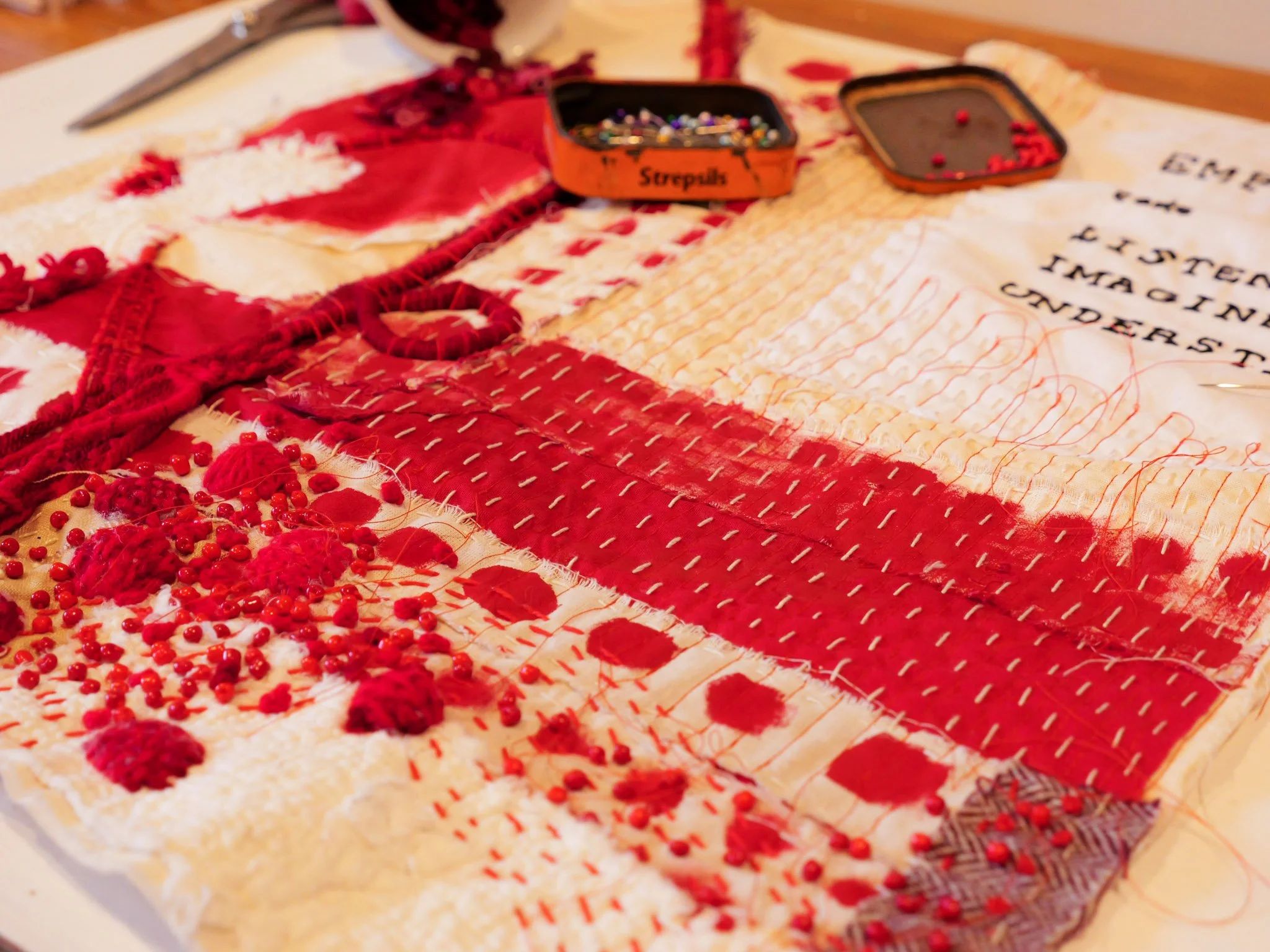
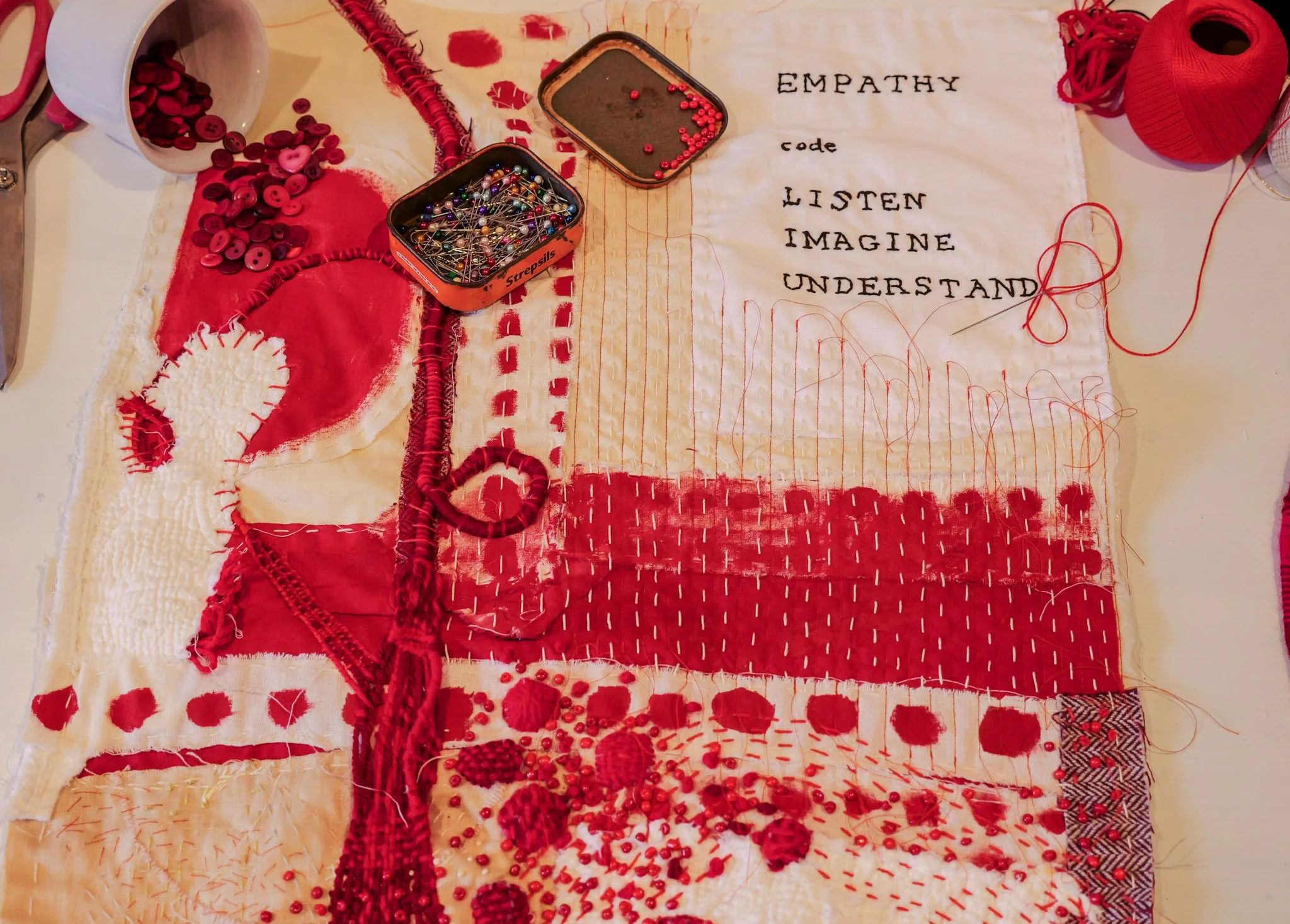
My artistic process and the need for a “shit” pile.
Early on in my teaching career as a high school drama teacher I specifically remember listening to an interview with the lead singer of the Nine Inch Nails, Michael Trent Reznor, on Triple J ABC Radio on my way to work. Reznor was talking about his artistic process and what he said has stayed with me ever since. I now feel like I deeply understand what he was articulating.
He recalls that he writes everyday, without fail. At the end of the session he has two piles on his desk: the good pile and the “Shit” pile. He puts the things that he liked and showed promise in the good pile and the things he hated in the “Shit” pile. But here’s the thing that stuck with me; he never ever throws away the shit. Instead he revisits the work months, sometimes years later, and he sees it through a different lens and often he likes the writing and it ends up in his songs.
Why is all of this important?
Early on in my teaching career as a high school drama teacher I specifically remember listening to an interview with the lead singer of the Nine Inch Nails, Michael Trent Reznor, on Triple J ABC Radio on my way to work. Reznor was talking about his artistic process and what he said has stayed with me ever since. I now feel like I deeply understand what he was articulating.
He recalls that he writes everyday, without fail. At the end of the session he has two piles on his desk: the good pile and the “Shit” pile. He puts the things that he liked and showed promise in the good pile and the things he hated in the “Shit” pile. But here’s the thing that stuck with me; he never ever throws away the shit. Instead he revisits the work months, sometimes years later, and he sees it through a different lens and often he likes the writing and it ends up in his songs.
Why is all of this important?
Because it reframes “perceived” failure.
What Reznor describes isn’t about separating good work from bad work — it’s about refusing to decide too quickly what has value. The “shit pile” isn’t a bin; it’s a holding space. A pause. An acknowledgement that creative work doesn’t always reveal its usefulness on the day it’s made.
As artists, we are often too close to our own work. We judge it through the lens of expectation, mood, exhaustion, or comparison. What feels flat or unresolved today may simply be unfinished — not a failure. Time adds context. Distance adds generosity.
This idea fundamentally changed the way I create in the studio or on the workshop floor with my students.
In the classroom, students often want to know immediately if something is good. They want reassurance and certainty. But creativity doesn’t work on a linear timeline. Some ideas need to sit quietly before they speak. When we discard work too quickly, we train ourselves to only value what is instantly successful — and that narrows the field of what we’re willing to try.
In my own artistic practice now, I see the “shit pile” as essential. It’s evidence of showing up. Of taking risks. Of moving through discomfort rather than around it. The pile grows because I am working not because I am failing (and believe me, my pile is getting very big).
And here’s the quiet truth: many of the works I now feel most connected to began as things I didn’t understand, didn’t like, or didn’t trust yet. They needed time for me to catch up to them.
This is why process matters more than outcome. Why play matters more than polish. Why nothing is ever wasted if you’re paying attention.
The work you’re unsure about today may be the work that teaches you the most or becomes something entirely different tomorrow.
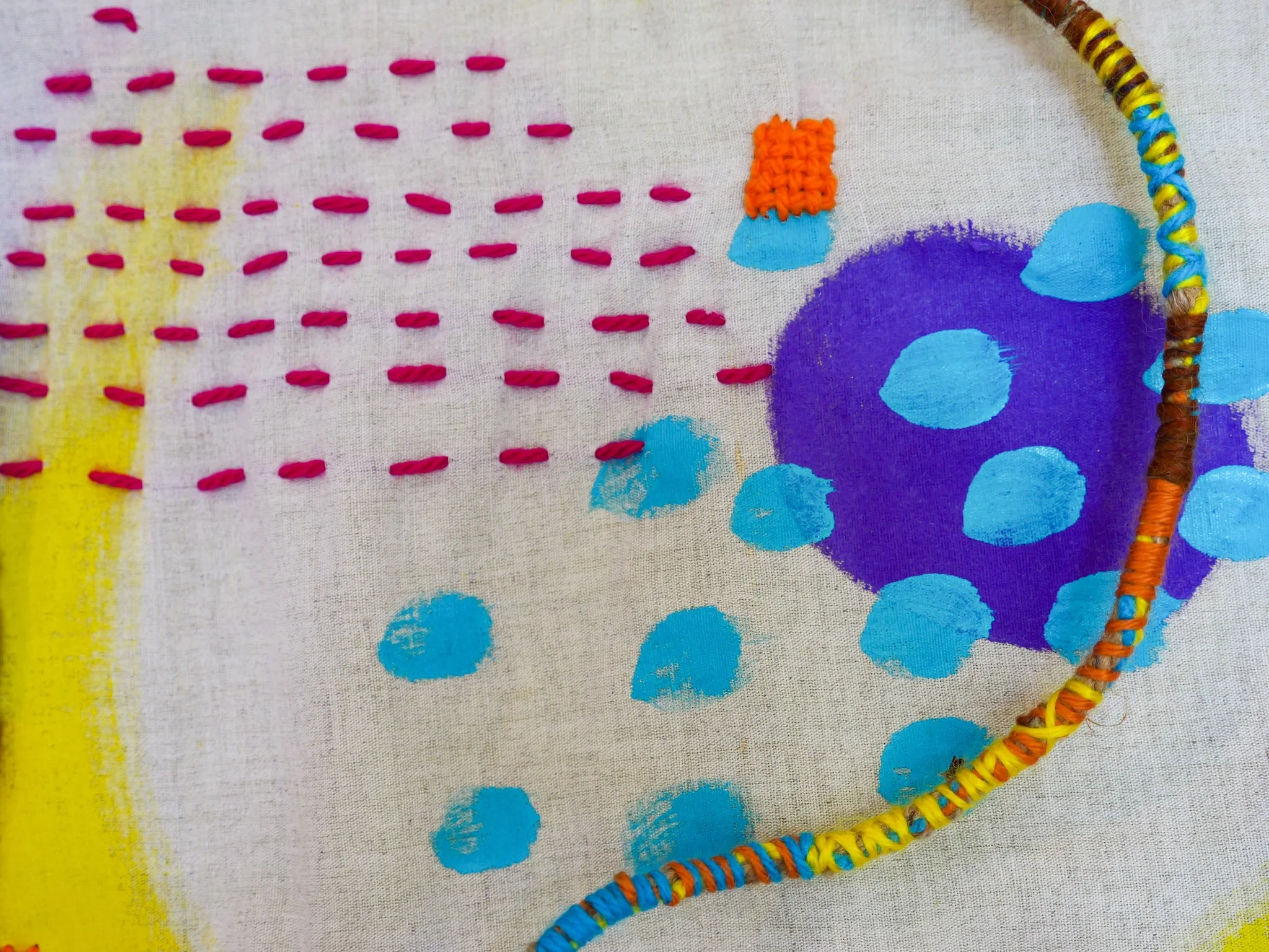
Detail of hand painted linen fabric with embroidery sections.
STORY
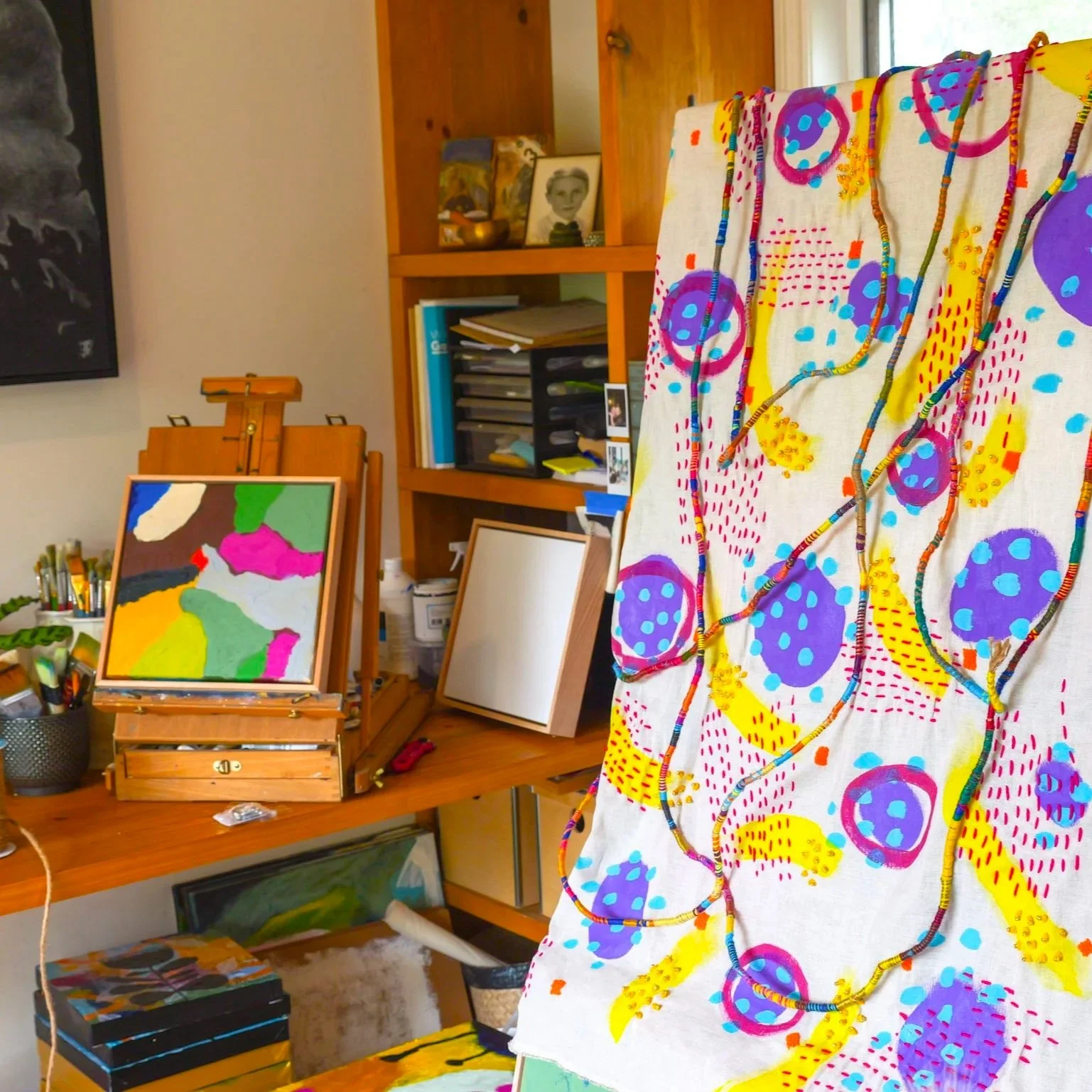
About two years ago I had a fantastic idea (aren’t they all fantastic in your head) to purchase some beautiful organic linen and hand paint it to turn into an item of clothing. So I set myself up outside in the dappled sunlight and got to work.
Well that day was a major disappointment and needless to say the fabric was quite heftly thrown into the “shit” pile … and stayed there for more than two years, until the other day when I pulled it out and reconsidered it.
I felt like it had promise and so picked it up again.
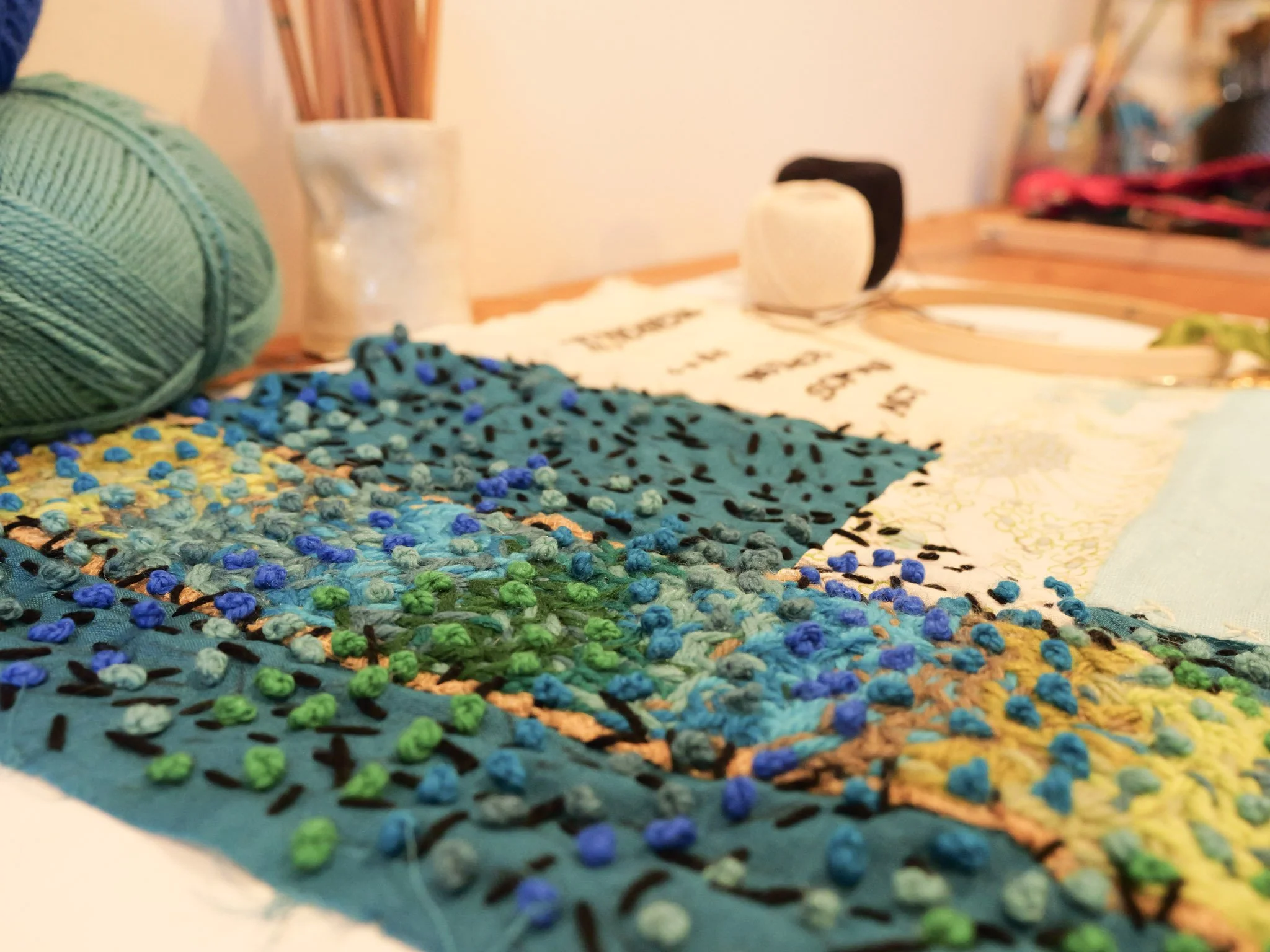
I started with some embroidery; running stitches, followed by some woven and french knot stitches and as the work progressed I realised that this piece hadn’t been given it’s full consideration. It was merely the base layer that was crying out for texture.
This then led to some bead application; gold beads being sewn into the yellow french knots. With more beads to be applied at as the days progress. And only now can I start to see the light at the end of the tunnel. By the way, I don’t actually know what it will look like and what it will evolve into, but I feel confident in the process of playing with the piece to work that out.
And I think there in lies my process: I play until the piece finds me.
I wish I could pull out my artists journal and show you the thought process behind my pieces but I simply can’t do that - I don’t work that way.
I work through making things in response to colour, shapes, texture and feelings. When I walk throughout the day I’m constantly making a mental note of how a colour appeared, the shape it held in contrast to another, how it felt to touch it and how it made me feel. When I paint or make something, these reference points often come back to me.
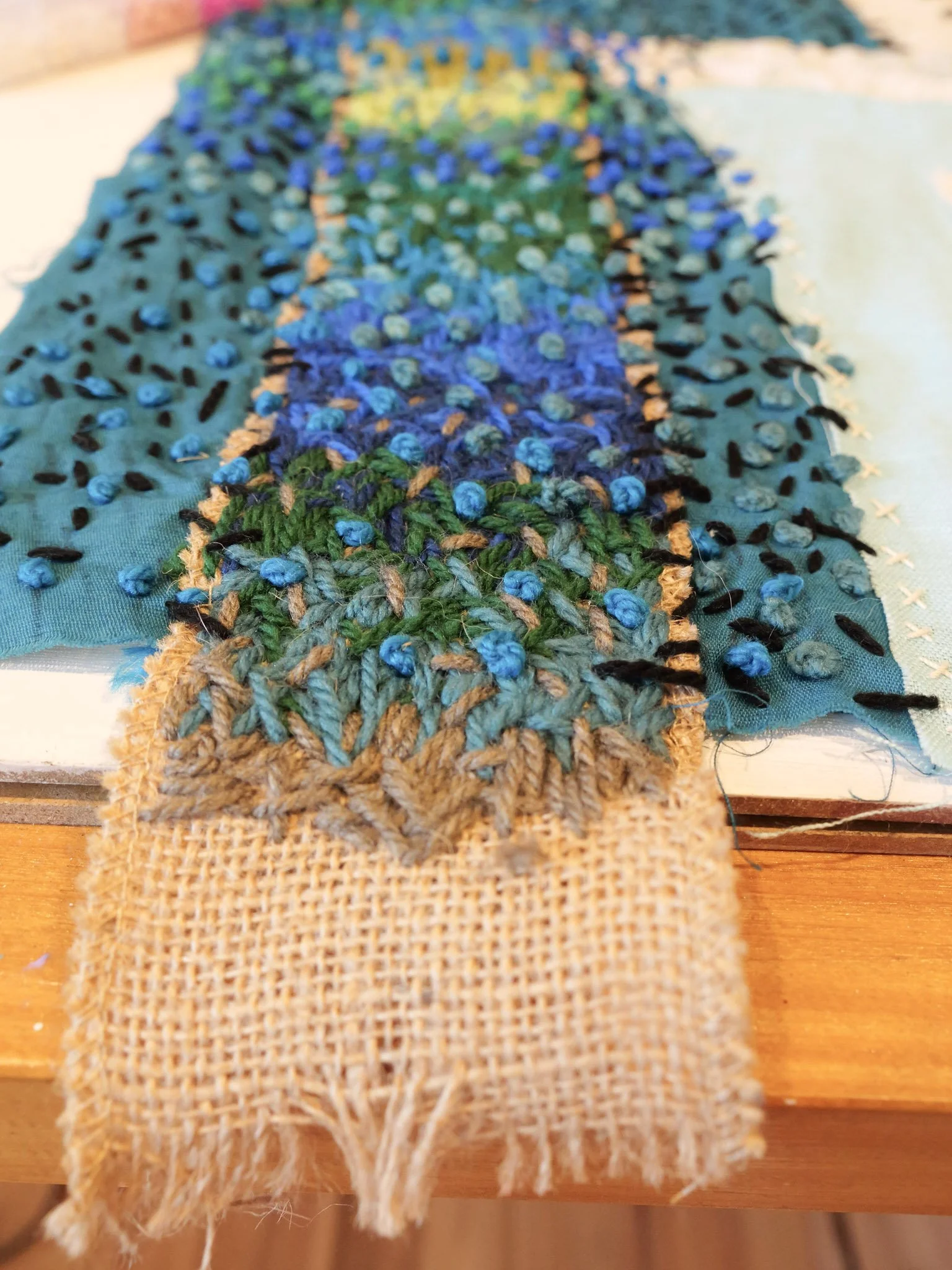
I now am able to bring in other pieces from my piles of stuff and see if they work with this piece: the 20 meters or more of woven rope, the hand stitched embroidery piece that actually started as a practice piece and so many more.
The options are endless.
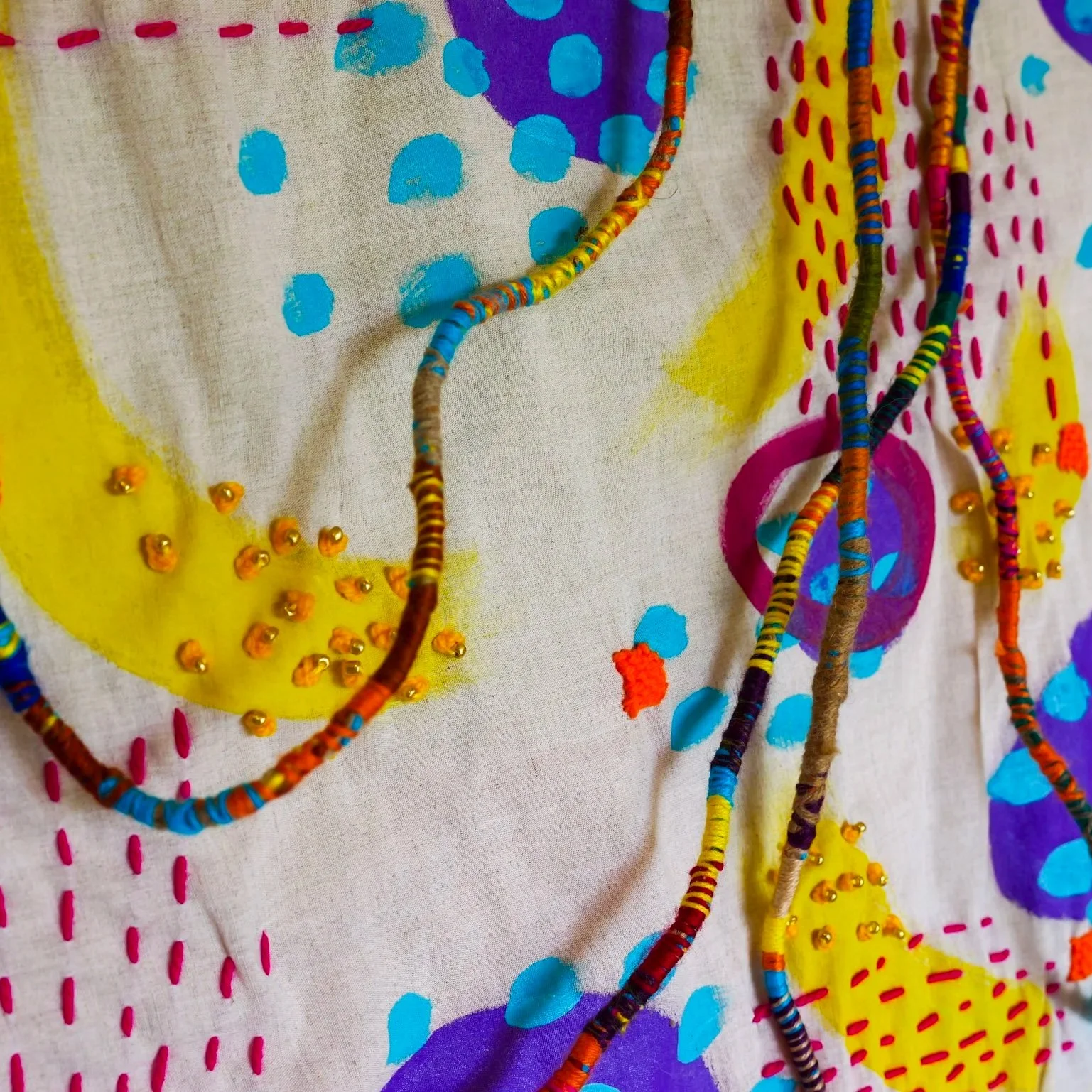
Detail of bead work application and woven rope being investigated.
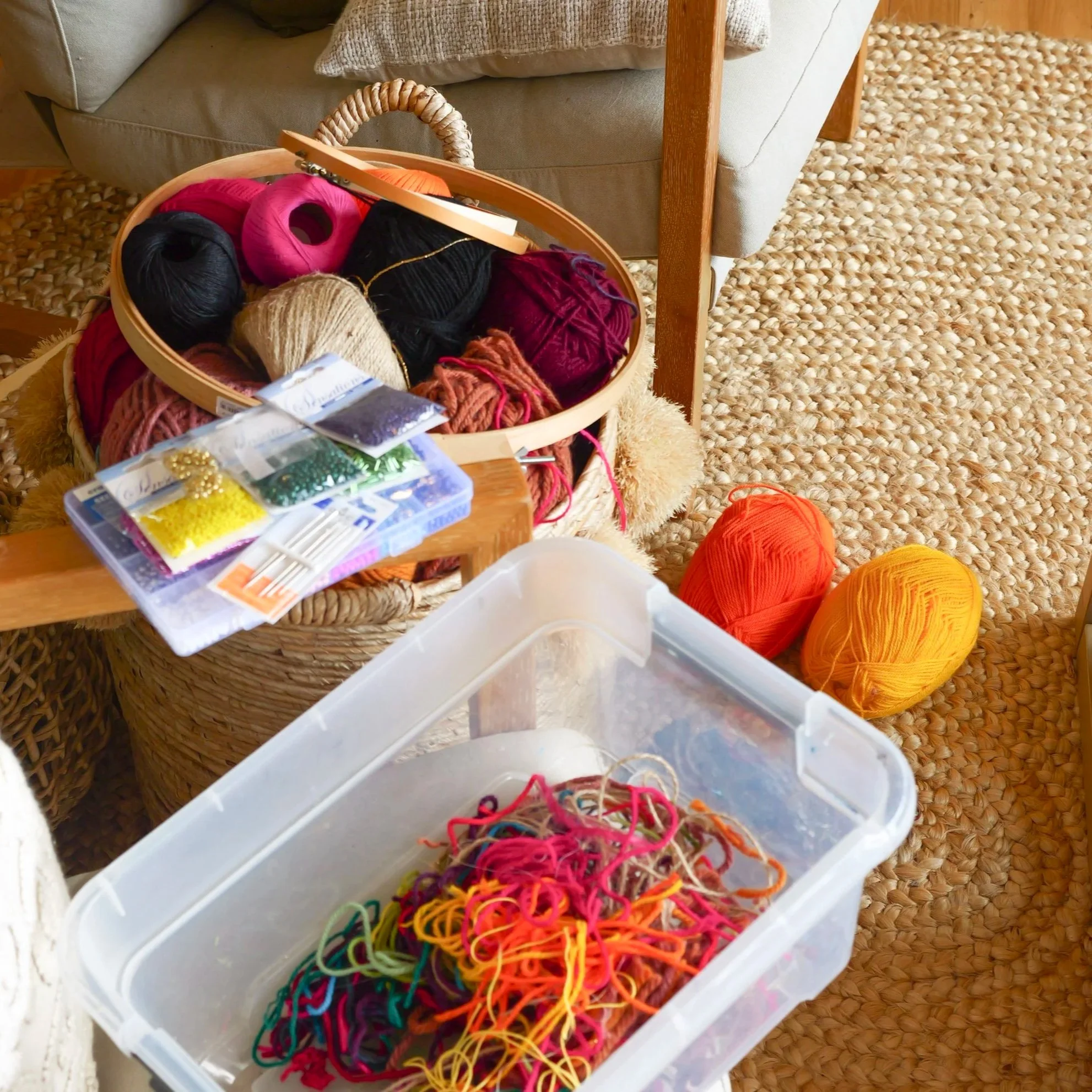
The pile of materials that sit by my side.
CHILDHOOD GAMES
When I was very little, my Dad and I had a marvellous game we’d play. He’d put a giant piece of paper out on the kitchen bench and one single pencil. We’d take turns drawing/creating a “place”. Once you’d added single element, you’d hand the pencil over to the other person and it would be their turn. They would get to work on adding their own unique element that in some way had relationship to what had already been built. This process could take hours and even days. They were often funny and if you could add a surprising piece of humor this made the game that much more fun.
My Dad being who he was, would always add vast landscapes with medieval armies and castles. For some reason or other that is always what eventuated. And it was always done in stick figures. By the time the drawing were finished they almost had a feeling of “The Triumph of Death” painting; any place you looked on the drawing there was something going on. I suppose the modern version of this is SIMS or Minecraft. You’re staying in the present moment to accumulate a world never quite knowing what the end point is.
And so I think my artistic process has almost turned into an homage of how I use to play with my Dad, continuous drawing / making.
I don’t know what something is yet, whilst I’m in the process of making and that’s not a problem.
I’m trying to resist premature judgement and trust that meaning, form, and clarity will arrive later often when I return with fresh eyes.
I might not have fully grasped why Reznor’s “shit pile” was as meaningful back in 1999, but needless to say I am grateful for the “shit” pile.
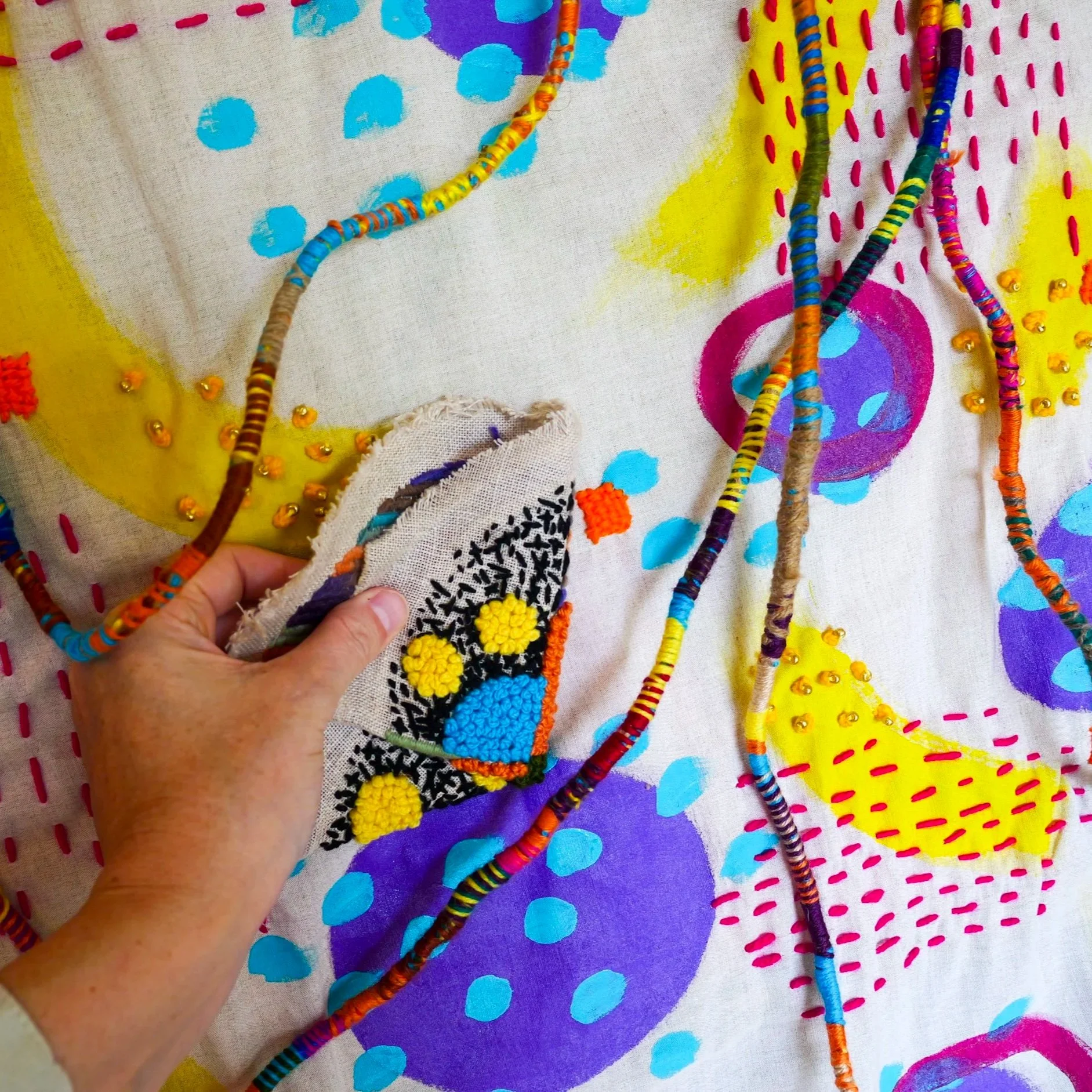
Maybe some black hand stitching built into it like this textile practice piece?
Perhaps applying some circular baubles to add depth and texture?
A picture of my late Dad as a child sits in my studio, always by my side.
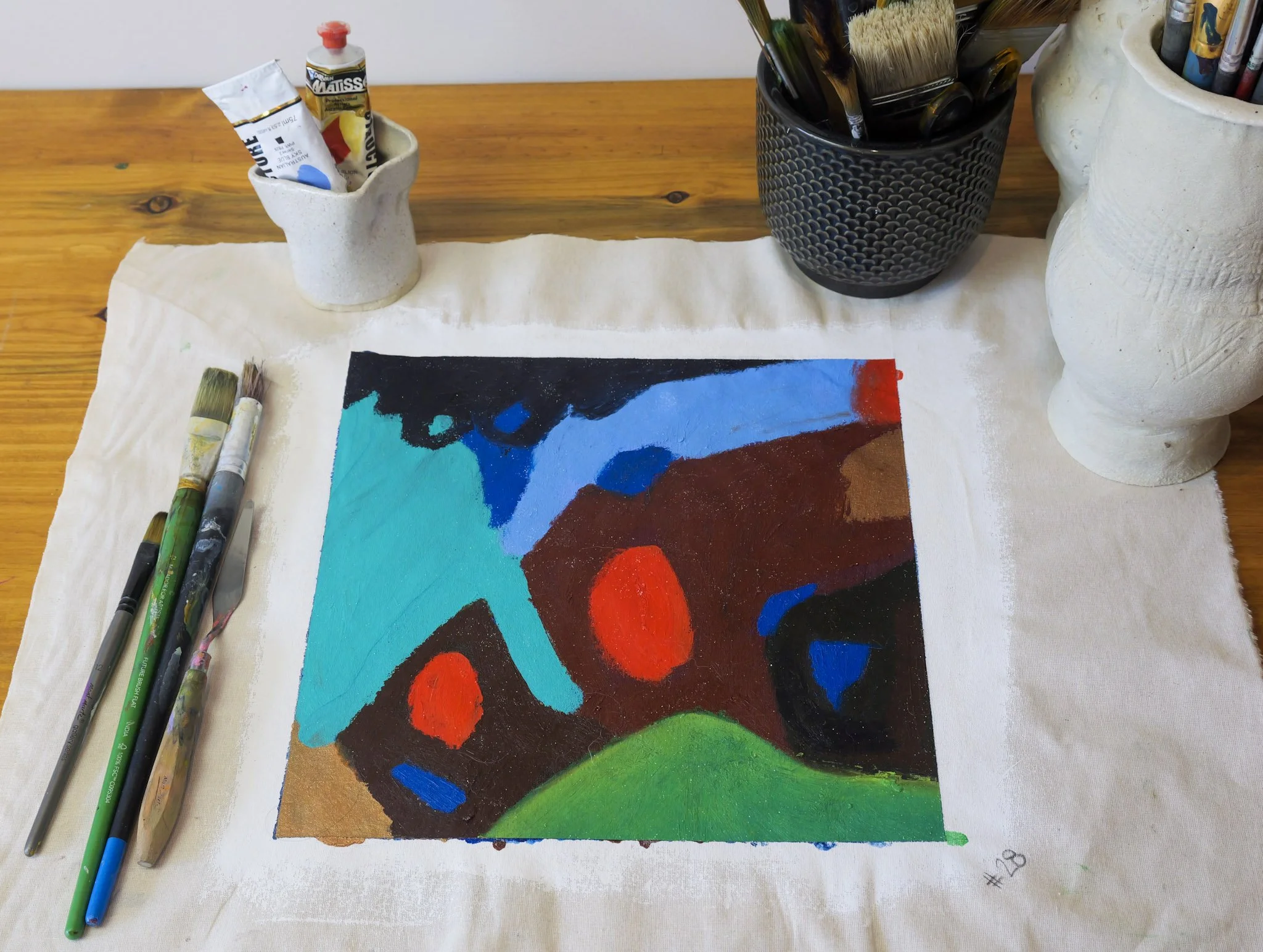
Art Mirrors Life
It All Begins Here
Day 28 30-Day Art Challenge October 2025 (Marie-Louise Bahnson)
The way you approach the canvas reflects how you approach uncertainty, risk, and people.
The way you make art is rarely just about art.
How you approach the canvas — tentative or decisive, open or guarded, patient or rushed — often reflects how you move through the world. Creative habits don’t exist in isolation. They echo your relationship with uncertainty, risk, and connection.
The work becomes a mirror.
Facing the Unknown
Every blank canvas holds uncertainty.
There’s no guarantee the first mark will lead somewhere meaningful. You choose where to begin without knowing how the piece will resolve — or if it will at all. This moment asks for the same qualities life does: trust, courage, and a willingness to step forward without certainty.
Avoidance shows up quickly. So does bravery.
Risk and Response
Art reveals how you handle risk.
Do you commit fully, or test cautiously at the edges? Do you allow mistakes to inform the next move, or do you retreat at the first sign of discomfort? These responses mirror how you engage with challenge beyond the studio.
The canvas doesn’t judge — it simply reflects.
Control and Release
The balance between control and surrender appears in both art and life.
Too much control can stifle growth. Too little can feel ungrounded. Finding the middle ground — where intention and openness coexist — is a practice that extends well beyond the work itself.
The way you negotiate this balance becomes visible in every layer.
Relationship and Presence
Art is a relationship.
It responds to attention, patience, and listening. When rushed or ignored, it resists. When met with presence, it opens. This dynamic mirrors how we relate to people — how deeply we listen, how much space we allow, how willing we are to stay with discomfort.
The quality of attention matters.
Learning From the Reflection
The canvas offers feedback without commentary.
If you’re willing to observe honestly, it shows you where you hesitate, where you overcompensate, and where you trust yourself. These insights extend beyond the studio, quietly shaping how you move through the world.
Art doesn’t just express life.
It teaches you how to live it.
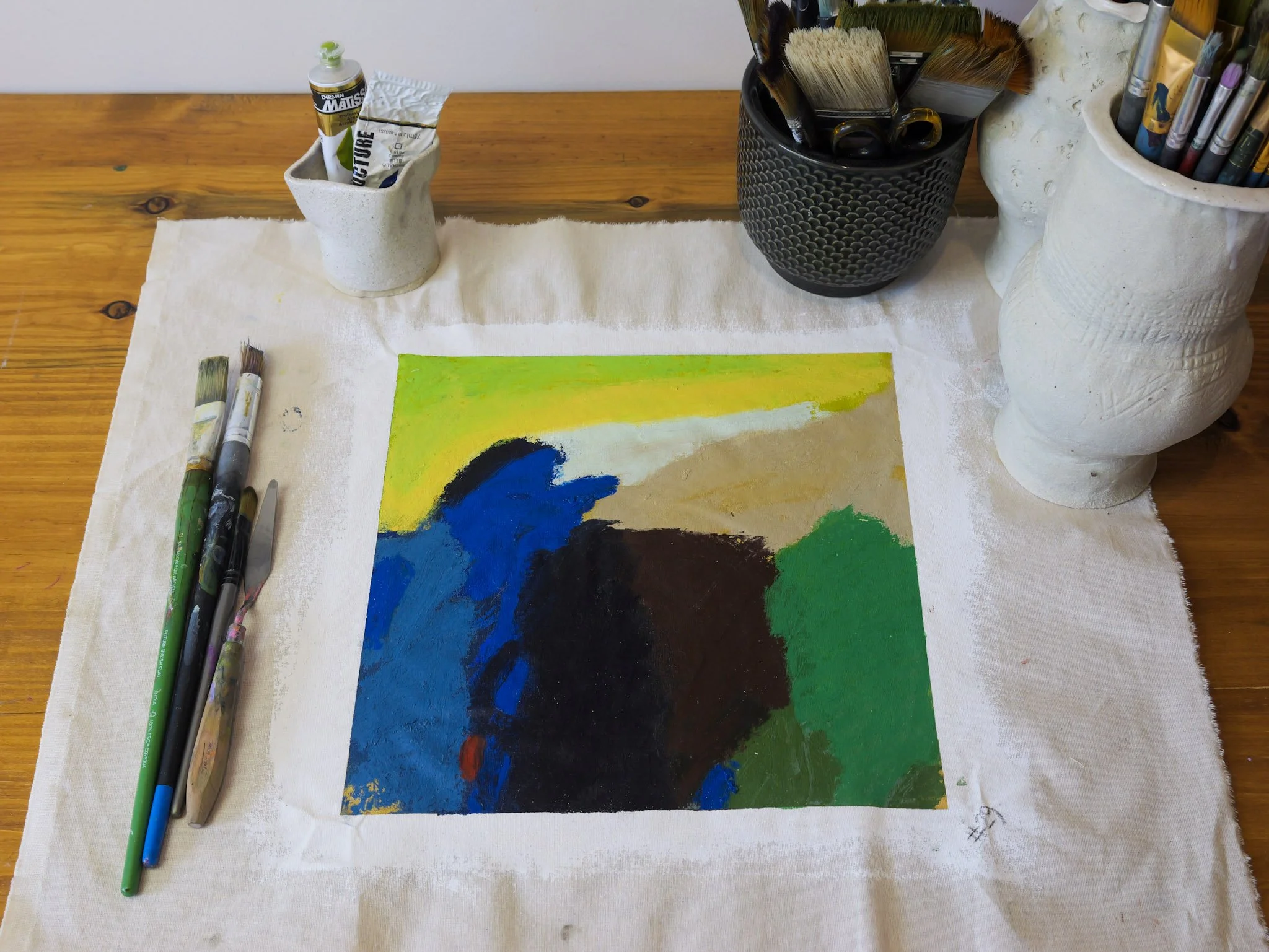
Progress Isn’t Linear
It All Begins Here
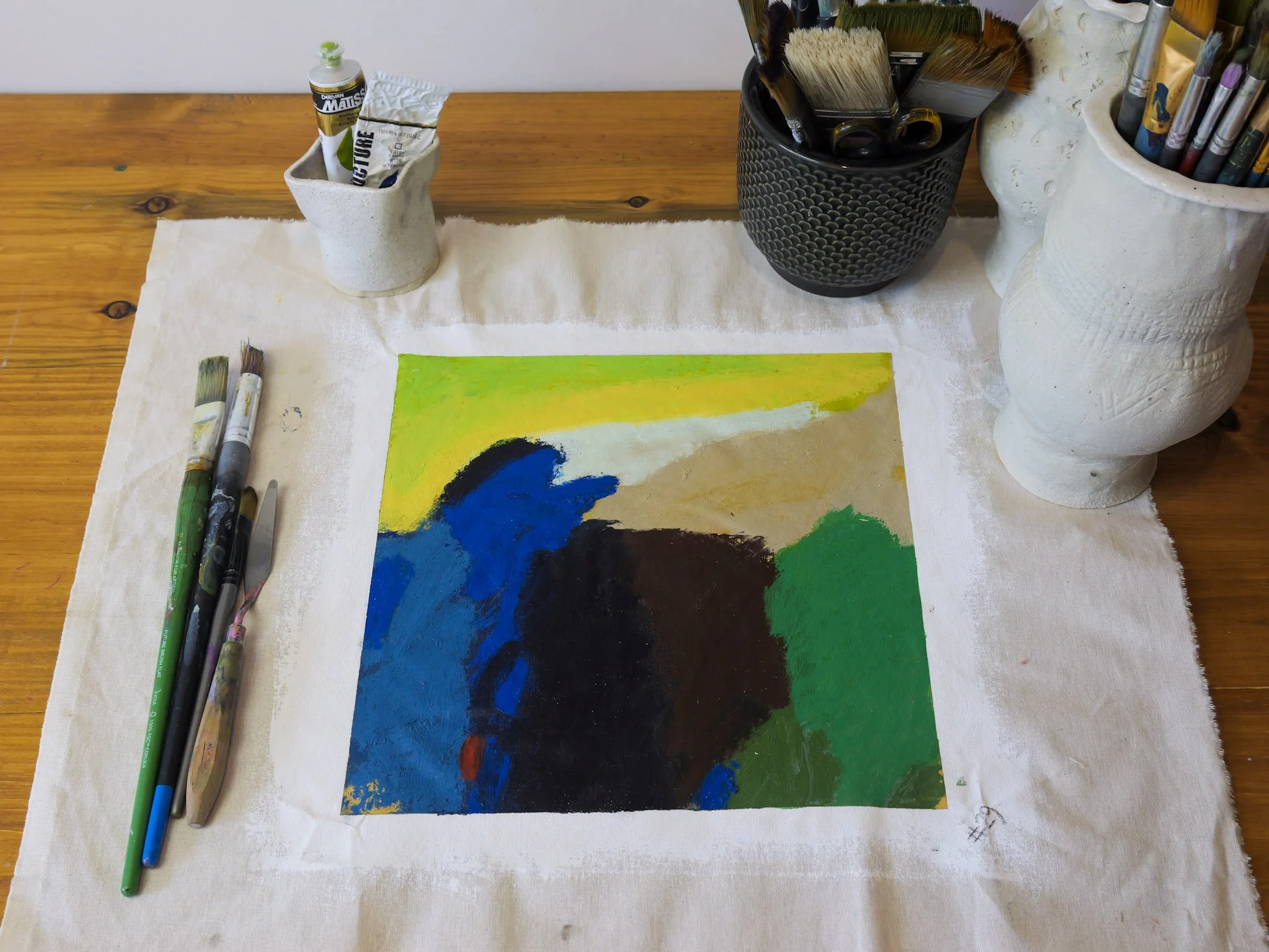
Day 29 30-Day Art Challenge October 2025 (Marie-Louise Bahnson)
Some days feel like breakthroughs, others like setbacks, but both matter equally.
Progress rarely moves in a straight line.
There are days when everything clicks, when clarity arrives, confidence lifts, and the work feels expansive. And then there are days that feel like reversals. Uncertain. Heavy. As though you’ve gone backwards.
Both are part of the same process.
The Myth of Constant Growth
We’re often taught to expect steady improvement.
More skill. More certainty. More ease. But creative growth doesn’t follow a predictable upward path. It loops, stalls, accelerates, and retreats. What feels like a setback is often a period of integration where learning settles beneath the surface.
Not all progress is visible.
Breakthroughs Need Grounding
Breakthrough moments are energising.
They open new possibilities and expand what feels achievable. But without quieter periods to absorb them, they remain unstable. Growth needs consolidation, time to test, repeat, and refine what’s been discovered.
The slower days anchor the faster ones.
Setbacks as Signals
Days that feel unproductive often carry important information.
They highlight habits that no longer serve you, assumptions that need questioning, or skills that need strengthening. Resistance can be a sign that you’re on the edge of something new, not that you’re failing.
Listening matters more than judging.
Equal Weight, Shared Purpose
Breakthroughs and setbacks aren’t opposites.
They work together. One stretches you forward; the other deepens your foundation. Each contributes to the overall direction, even when it’s hard to recognise in the moment.
Progress is cumulative, even when it feels uneven.
Staying the Course
The work asks for patience.
It asks you to stay present through fluctuation, to keep showing up without demanding constant proof that it’s working. Over time, patterns emerge. Perspective widens. What once felt chaotic begins to make sense.
So keep going. Through the highs and the lows.
Progress may not be linear, but it is real.
Play is SERIOUS Work
It All Begins Here
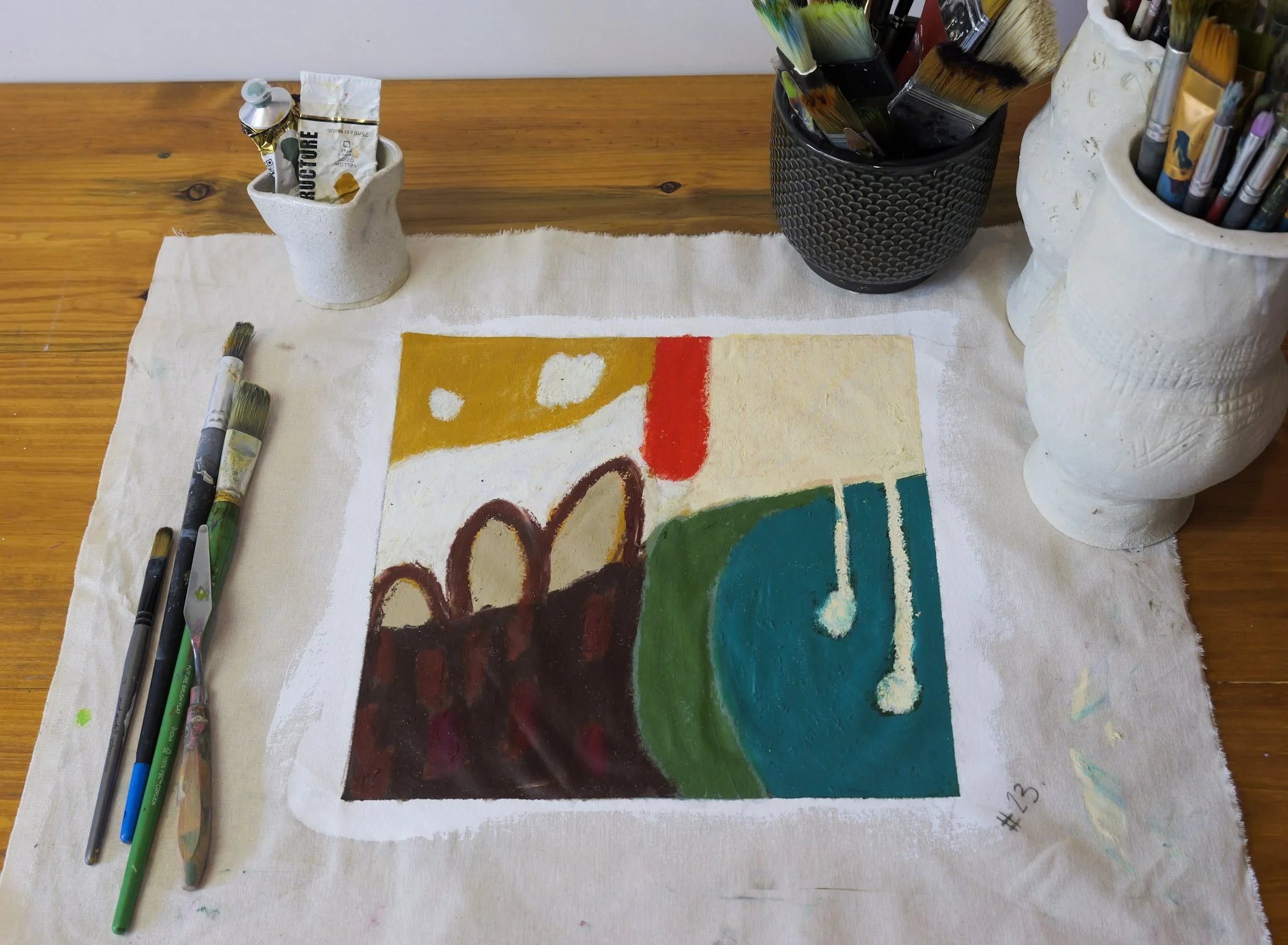
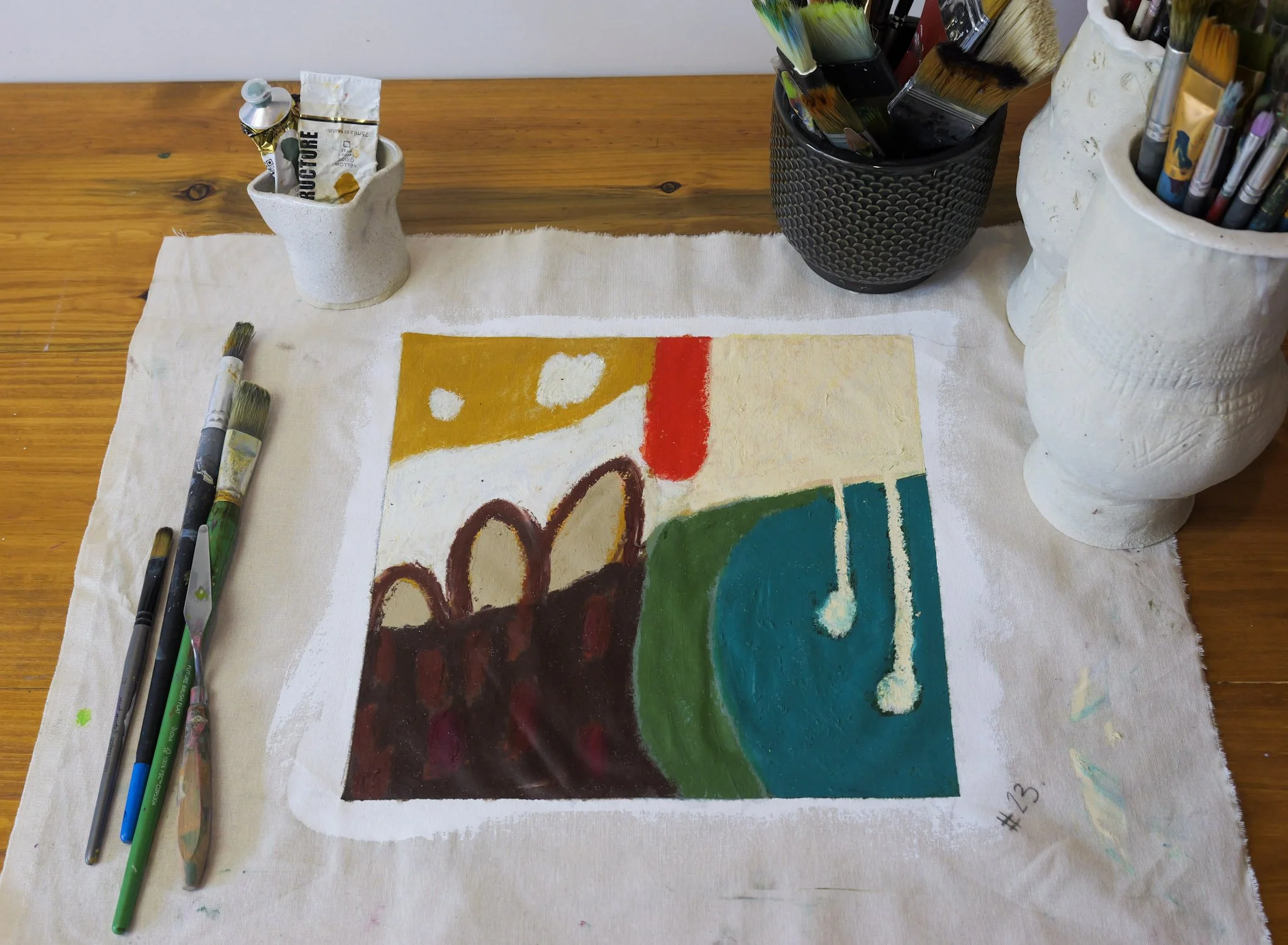
Day 23 30-Day Art Challenge October 2025 (Marie-Louise Bahnson)
The more you treat play as a practice, the more meaning appears in the work.
Play is often misunderstood.
It’s seen as frivilous, optional, or indulgent; something you return to once the real work is done. But in creative practice, play isn’t a detour. It’s a method. It’s vital!
When play is treated seriously, meaning begins to surface.
Play Without Pressure
Play removes the demand for immediate results.
There’s no expectation to resolve, explain, or justify. This absence of pressure creates space for curiosity, for marks made simply to see what happens next. The work becomes exploratory rather than performative.
In that openness, ideas breathe.
Practice, Not Distraction
Play is most powerful when it’s practiced consistently.
Returning to playful exploration trains flexibility. It keeps the work responsive and alive. Over time, patterns emerge, not through planning, but through repeated experimentation.
What begins as play often becomes the foundation of deeper, more resolved work.
Risk Lives Here
Play invites risk without consequence.
Because the stakes feel lower, you’re more willing to try what might not work. This is where unexpected breakthroughs occur; in gestures that weren’t overthought, in combinations that weren’t pre-approved.
Play gives permission to fail, and in doing so, expands what’s possible.
Meaning Through Engagement
Meaning doesn’t arrive through force.
It appears when you’re fully engaged: attentive, curious, and present. Play sharpens that engagement. It keeps the work connected to sensation rather than strategy.
The more you return to play, the more the work begins to speak on its own terms.
Taking Play Seriously
To treat play seriously is to honour its role.
It’s not separate from discipline or depth, it feeds them. Play sustains momentum, renews interest, and keeps the process human.
So make space for it. Return to it often.
Because when play becomes practice, the work gains both freedom and meaning.
Self-Doubt Never Disappears - It Just Gets Quieter
It All Begins Here
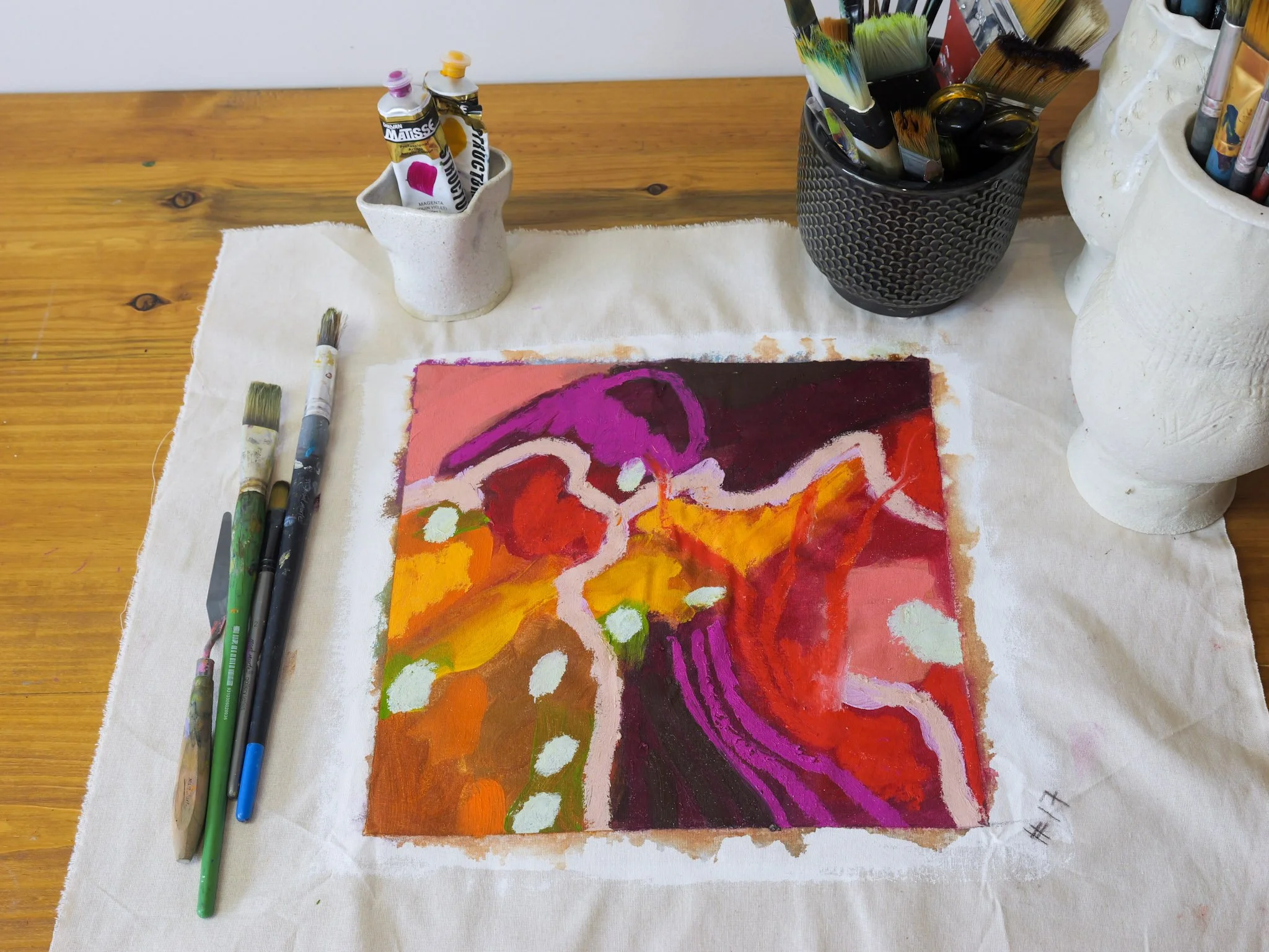
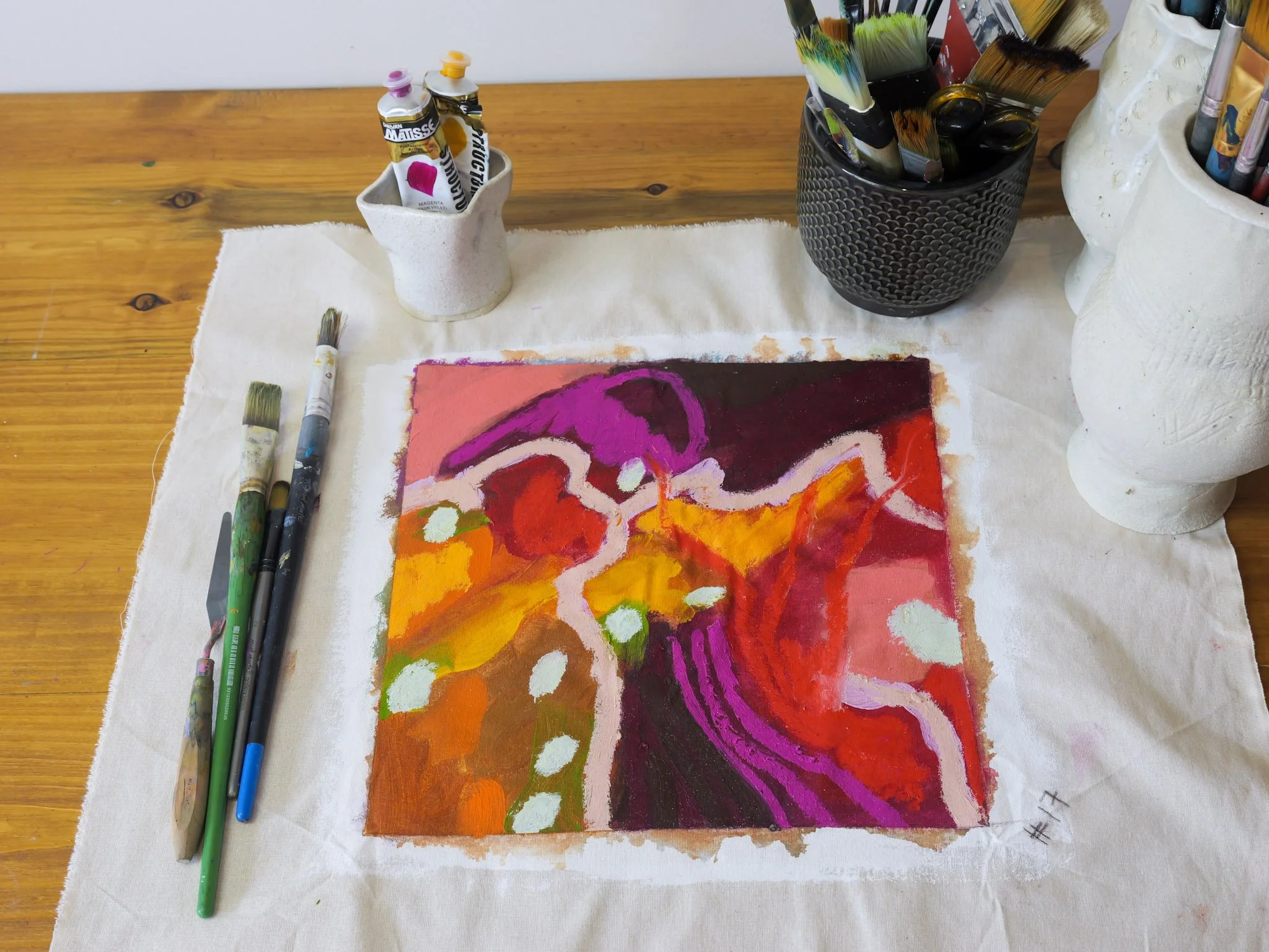
Day 17 30-Day Art Challenge October 2025 (Marie-Louise Bahnson)
Self-doubt doesn’t vanish with experience.
It doesn’t disappear once you’ve found your voice or built confidence. More often, it stays, quietly present and familiar. The difference isn’t whether it exists, but where it sits.
Think of self-doubt as a passenger in the car.
The Driver’s Seat
When self-doubt sits in the driver’s seat, everything slows.
Decisions become cautious. Direction becomes unclear. You second-guess instinct, avoid risk, and mistake hesitation for safety. Progress stalls, not because you lack ability, but because doubt is steering.
This is where self-sabotage begins: when fear is mistaken for wisdom.
Moving It Out of Reach
The goal isn’t to eject self-doubt from the car entirely.
That rarely works. Instead, it’s about relocation. When self-doubt is moved to the back seat, or better yet, the boot, it’s still present, but it no longer has access to the controls.
You can hear it faintly, but it doesn’t determine the route.
Learning to Drive Anyway
Confidence isn’t the absence of doubt.
It’s the willingness to keep moving despite it. Each time you act in the presence of uncertainty, doubt loses volume. Not because it’s proven wrong, but because it’s no longer being obeyed.
Momentum quietens the noise.
Practice Makes Distance
With repetition, the distance grows.
You begin to recognise doubt as information rather than instruction. A signal, not a command. Over time, it becomes easier to acknowledge it without reacting to it.
The work continues. The direction holds.
Staying in Motion
Self-doubt may always come along for the ride.
But it doesn’t get to choose the destination. When you decide where it sits, you reclaim agency in your practice.
So keep driving. Keep creating.
Let doubt ride quietly in the back, while you stay focused on the road ahead.
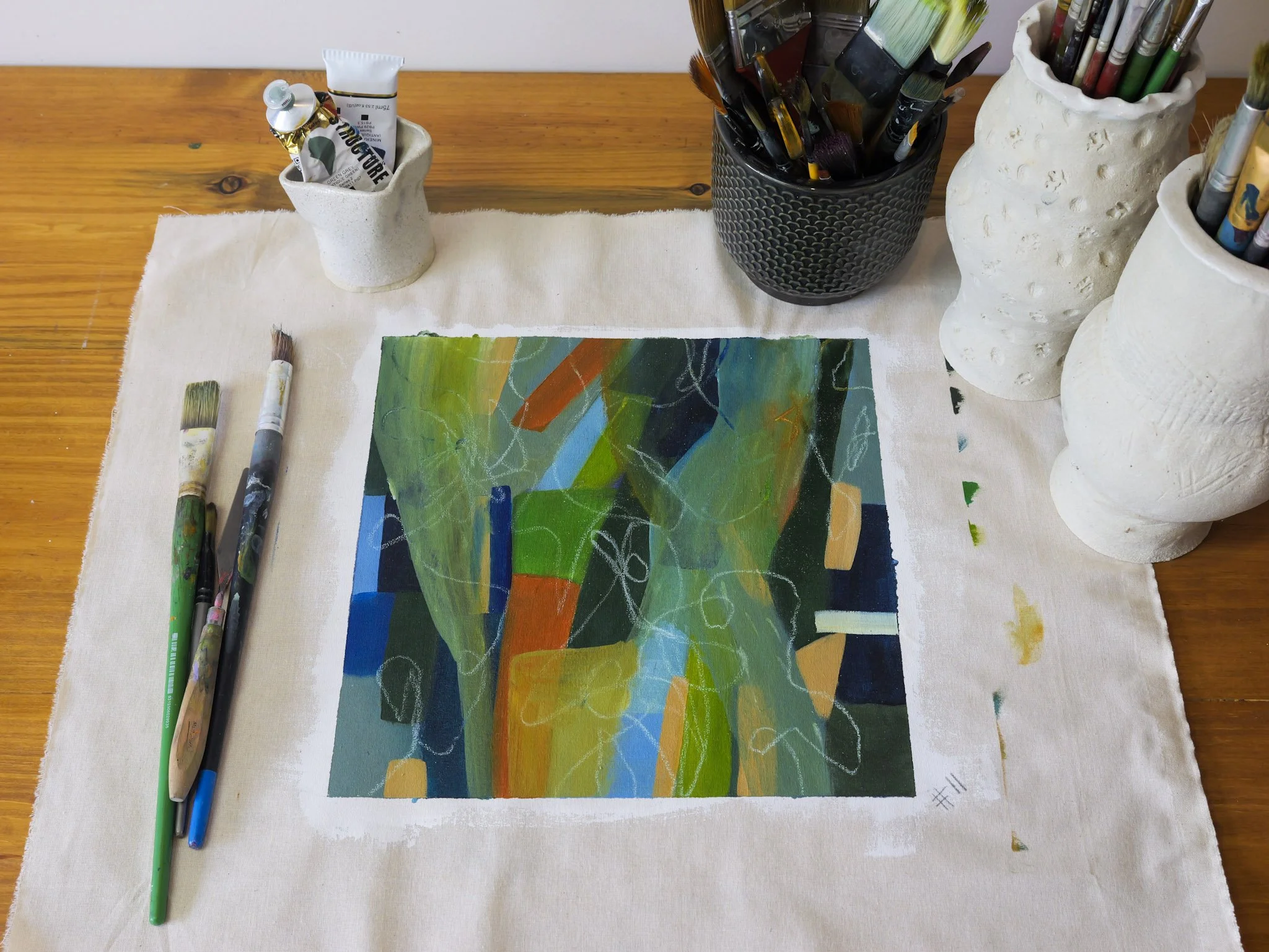
Discipline and Flow can Co-exist
It All Begins Here
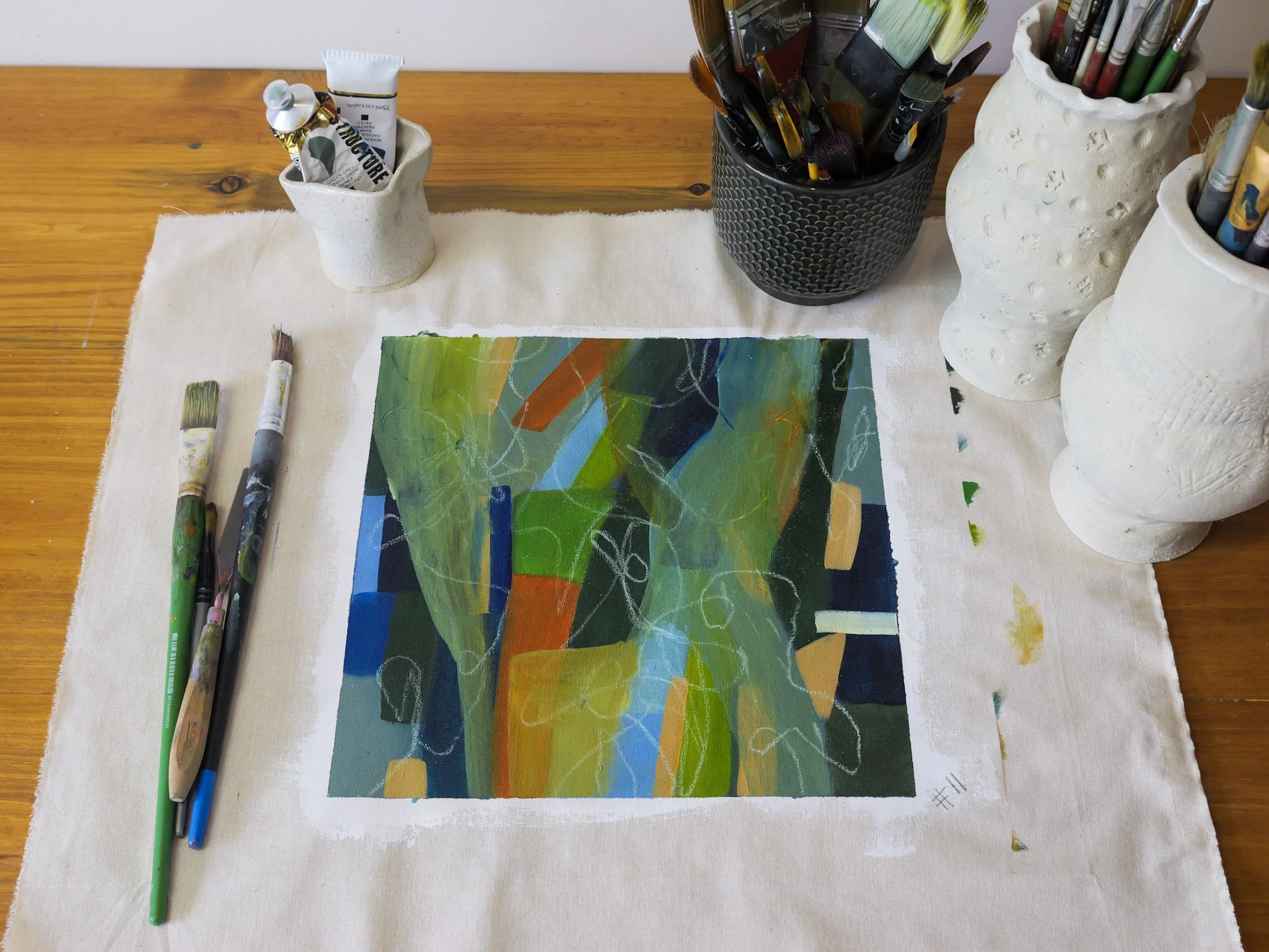
Day 11 30-Day Art Challenge October 2025 (Marie-Louise Bahnson)
Showing up every day turns creativity into a habit rather than a mood.
Discipline and flow are often framed as opposites.
One is seen as rigid, structured, and effortful. The other as expansive, intuitive, and effortless. But in creative practice, they don’t compete, they rely on each other.
Flow isn’t something you wait for. It’s something you build.
Showing Up Removes Negotiation
When creativity is treated as a mood, it becomes fragile.
Some days you feel inspired. Other days you don’t. And when inspiration becomes the gatekeeper, the work becomes inconsistent. Discipline changes that dynamic. Showing up every day removes the need to decide whether you feel ready.
The act of beginning becomes automatic. Resistance has less room to grow.
Habit as Creative Infrastructure
Routine doesn’t dull creativity, it supports it.
By returning to the work consistently, you create a stable container where experimentation can happen safely. The pressure to feel inspired dissolves, replaced by a steady rhythm of engagement.
Within that rhythm, flow appears more often not because it’s forced, but because the conditions for it have been prepared.
Flow Follows Action
Flow rarely arrives first.
It tends to emerge after movement, after the first marks, the first decisions, the first small commitments. Discipline gets you to the starting line; flow takes over once you’re in motion.
Waiting to feel ready delays the work. Starting invites the work to meet you.
Consistency Builds Trust
Each time you show up, you reinforce trust in yourself.
You prove that the work doesn’t depend on perfect circumstances. That you can create even when energy is low or confidence wavers. Over time, this builds a quiet resilience, a belief that the process will carry you through.
Discipline becomes less about control and more about care.
Where They Meet
When discipline and flow align, creativity feels grounded rather than chaotic.
You’re present without being precious. Focused without being rigid. The work unfolds naturally because you’ve created the space for it to do so.
Creativity thrives when it’s given both structure and freedom.
So show up. Again and again.
Let habit open the door and let flow walk through it.
Style Emerges Through Surrender
It All Begins Here
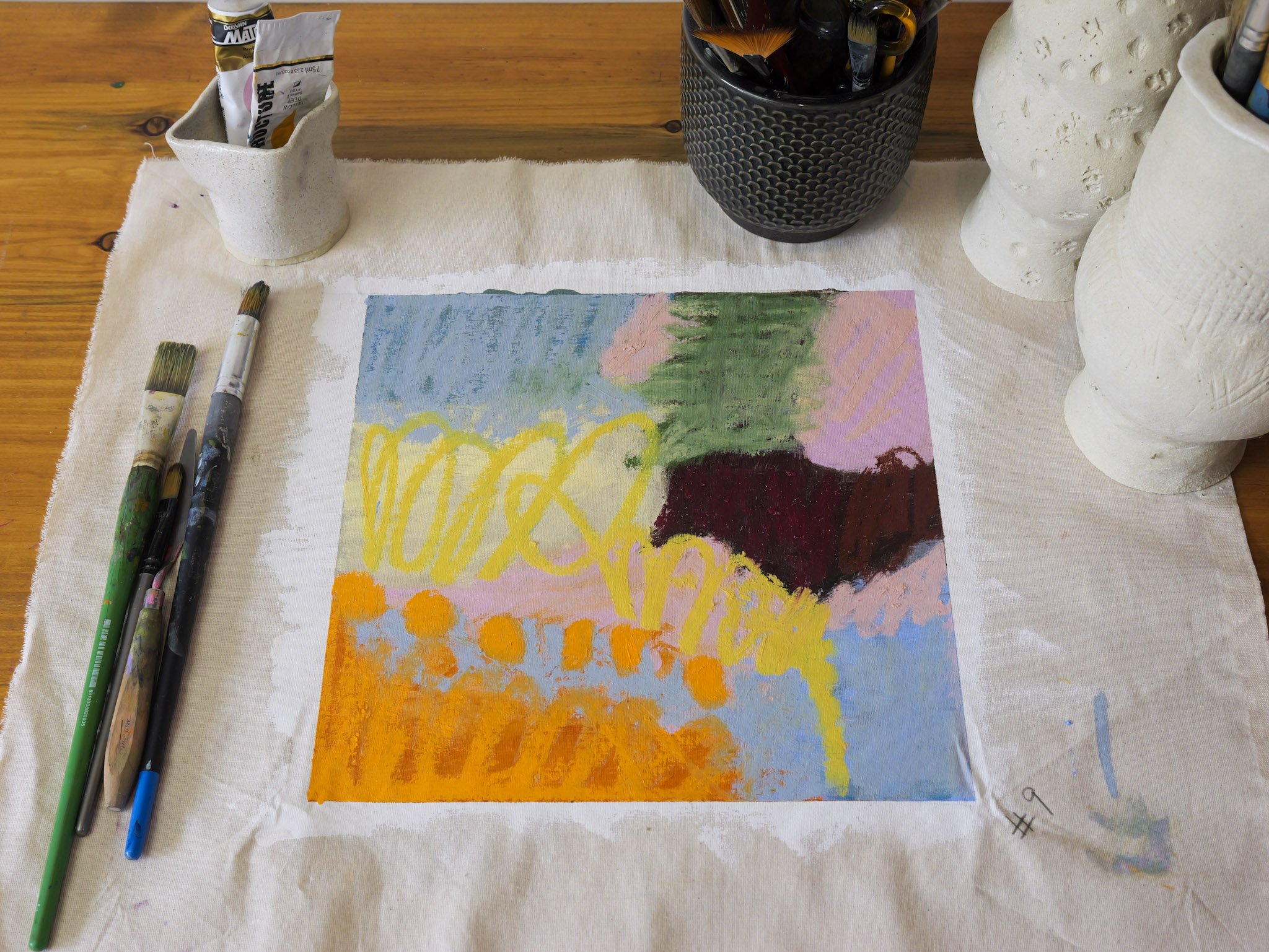
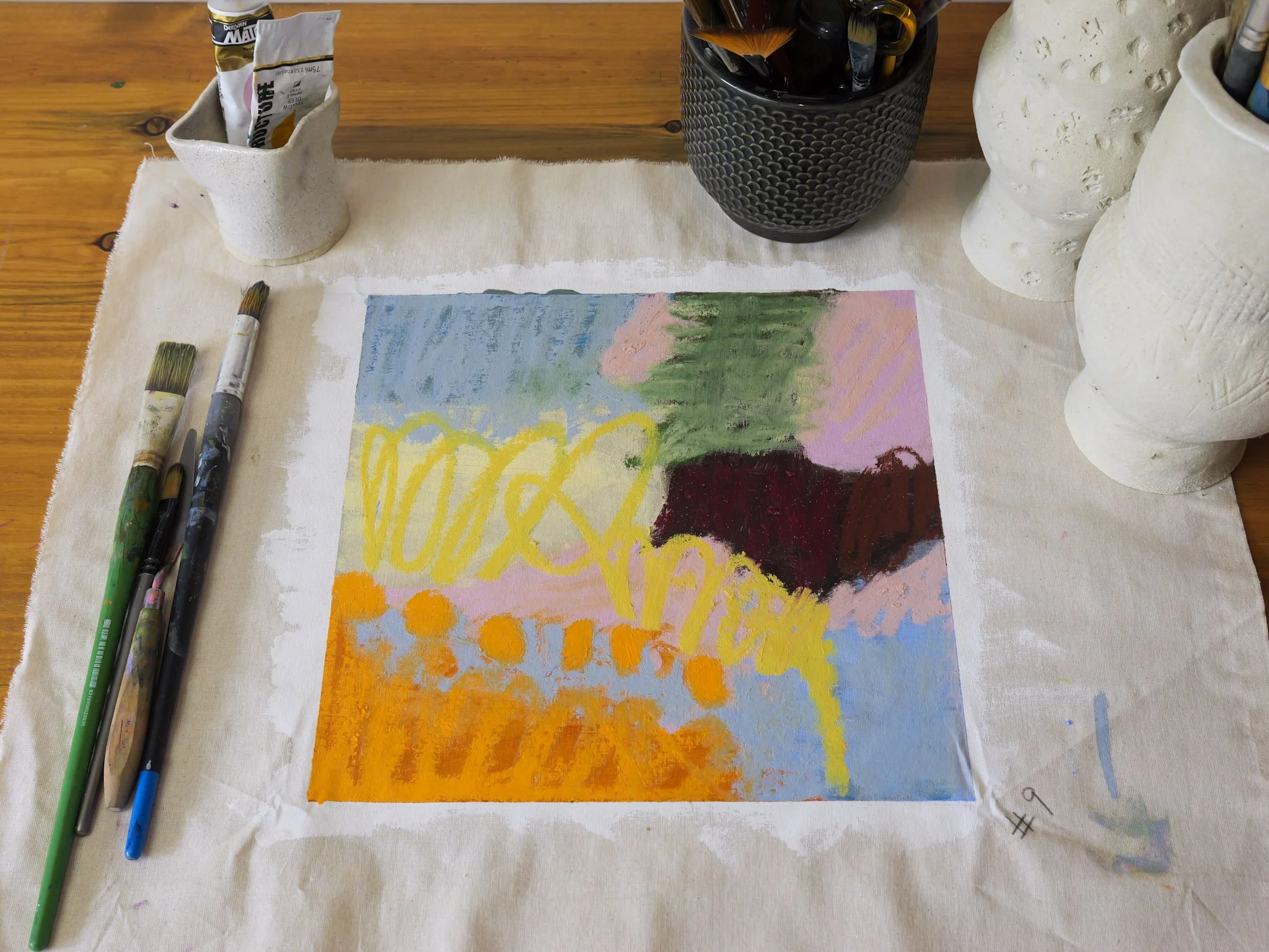
Day 9 30-Day Art Challenge October 2025 (Marie-Louise Bahnson)
The more you let go of control and comparison, the clearer your authentic voice becomes. It’s not found, it’s revealed.
Style isn’t something you chase.
It doesn’t appear through effort, trend-following, or comparison. In fact, the harder you try to define it, the further it seems to slip away. Style emerges when you stop trying to control the outcome and start allowing the work to unfold.
Letting Go of Control
Control often masquerades as discipline.
You plan. You refine. You second-guess. You hold back marks that feel too risky or too much. But over-control flattens instinct. It smooths out the very edges that give the work its character.
Surrender doesn’t mean chaos. It means trusting the decisions that arise in the moment before the mind has time to edit them into something safer.
The Weight of Comparison
Comparison is subtle, but heavy.
It pulls your attention outward, measuring your work against what’s already been seen, already been approved. The result is often work that’s technically competent but emotionally distant, filtered through someone else’s voice.
When comparison falls away, attention returns to the work itself. To what feels necessary rather than acceptable. This is where authenticity begins to surface.
Listening Instead of Directing
Surrender invites listening.
You start responding to what’s in front of you rather than imposing an idea onto it. The work becomes a conversation instead of a statement. Each decision builds on the last, guided by sensation, intuition, and attention.
This kind of making is slower, but deeper. Less performative. More honest.
Style as a Byproduct
Style is the residue of repeated, unfiltered choices.
It’s shaped by what you return to again and again: certain gestures, colours, rhythms, and instincts. Not because you decided they were your thing, but because they kept showing up when you weren’t interfering.
Over time, those patterns cohere. Others begin to recognise a voice long before you do.
The Quiet Confidence of Trust
Surrender builds trust in yourself and in the process.
You stop asking whether the work fits and start asking whether it feels true. The need for validation softens. The work stands on its own terms.
Style doesn’t announce itself. It accumulates quietly, through presence, repetition, and letting go.
So loosen your grip. Release the comparison. Trust what keeps emerging.
Your voice is already there waiting to be revealed.
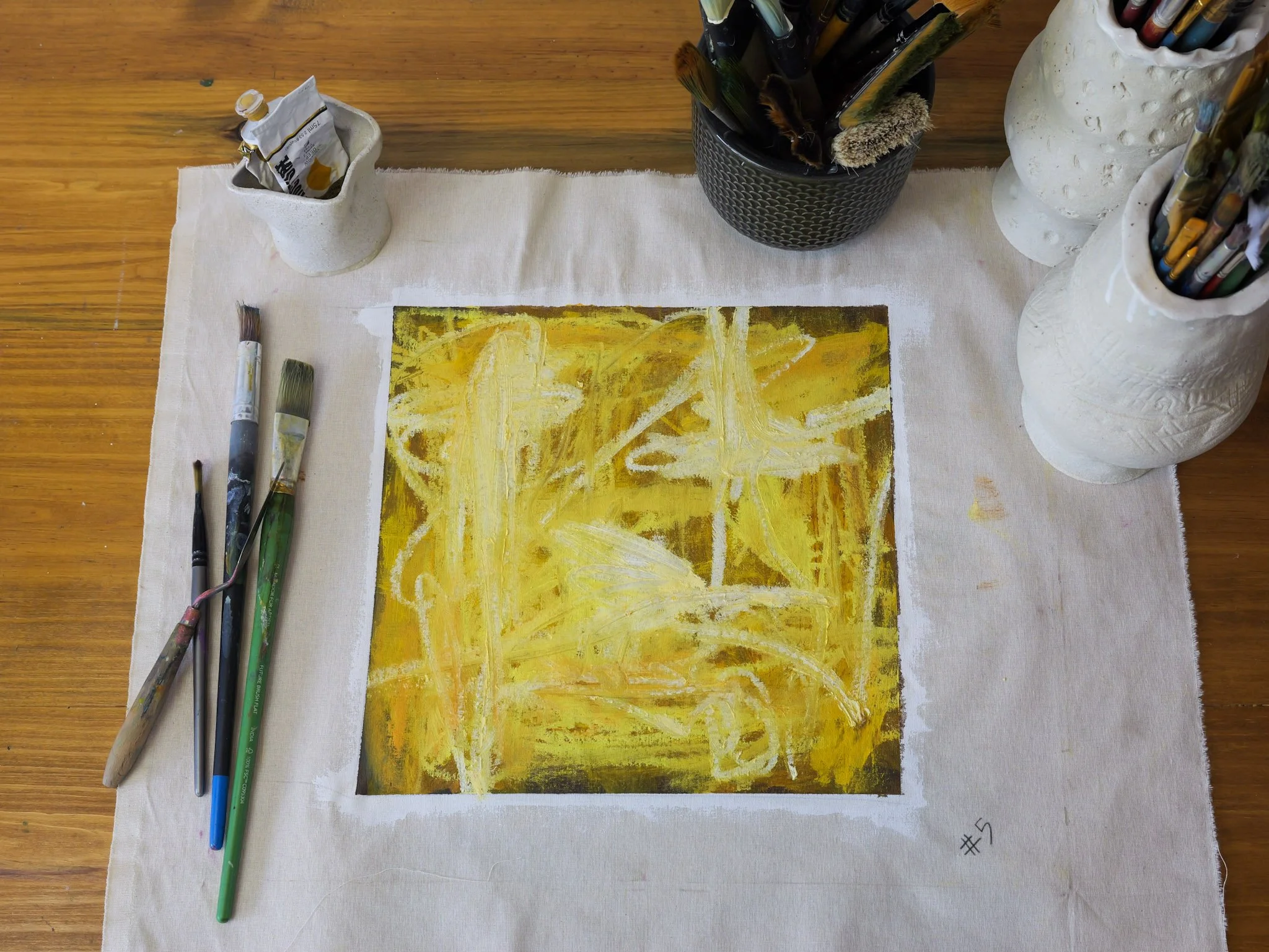
Repetition Builds Rhythm
It All Begins Here
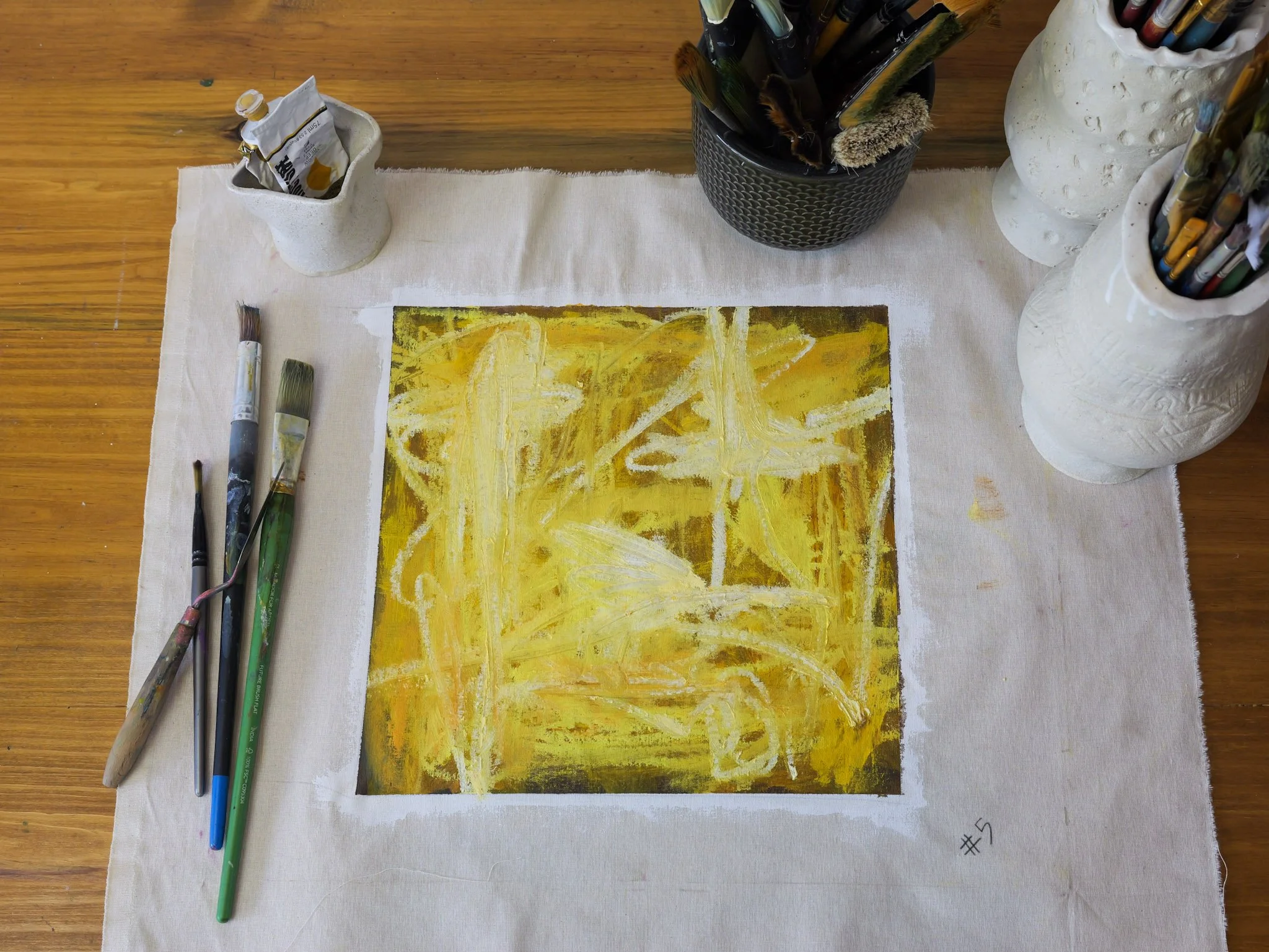
Day 5 30-Day Art Challenge October 2025 (Marie-Louise Bahnson)
Painting (creating and making) every day sharpens your eye, your timing, and your courage. You start to see not just what works, but why it works.
Inspiration often gets the credit, but repetition does the real work.
Creating every day: painting, drawing, making in any form, isn’t about producing something finished or successful each time. It’s about building familiarity. With your materials. With your instincts. With your own way of seeing.
Repetition turns effort into rhythm.
Showing Up Changes Everything
When you return to the work daily, something shifts.
The hesitation softens. The starting point becomes easier to find. You spend less time warming up and more time moving forward. What once felt awkward or uncertain begins to feel natural, not because it’s effortless, but because it’s familiar.
Consistency removes the drama. The work becomes a practice rather than a performance.
Sharpening the Eye
Repetition trains perception.
You start to notice subtleties that once slipped past unnoticed: balance, tension, proportion, colour, relationships. Patterns emerge. You begin to recognise what draws your attention and what distracts from it.
More importantly, you start to see why something works, not just that it does. This understanding doesn’t come from theory alone; it’s earned through doing the work again and again.
Timing and Restraint
Rhythm is about knowing when to act and when to stop.
Through repetition, timing becomes intuitive. You sense when a piece needs another mark and when it needs to be left alone. You develop restraint, learning that not every impulse needs to be followed.
This is where confidence grows, not in adding more, but in trusting what’s already there.
Courage Through Familiarity
Making daily builds a quiet kind of courage.
The fear of getting it wrong loses its edge because you know there’s always another chance tomorrow. Each session becomes less precious, which paradoxically makes the work stronger. Risk becomes part of the routine rather than an exception.
Courage, like skill, is built through repetition.
The Rhythm That Carries You
Over time, the work starts to carry its own momentum.
You’re no longer relying on motivation or mood. You’ve established a rhythm that supports you, one that keeps you moving even on slower days. The practice becomes a steady pulse, grounding the creative process.
Repetition isn’t about sameness. It’s about depth.
So keep showing up. Keep making. Let the rhythm build.
In time, it will guide you.
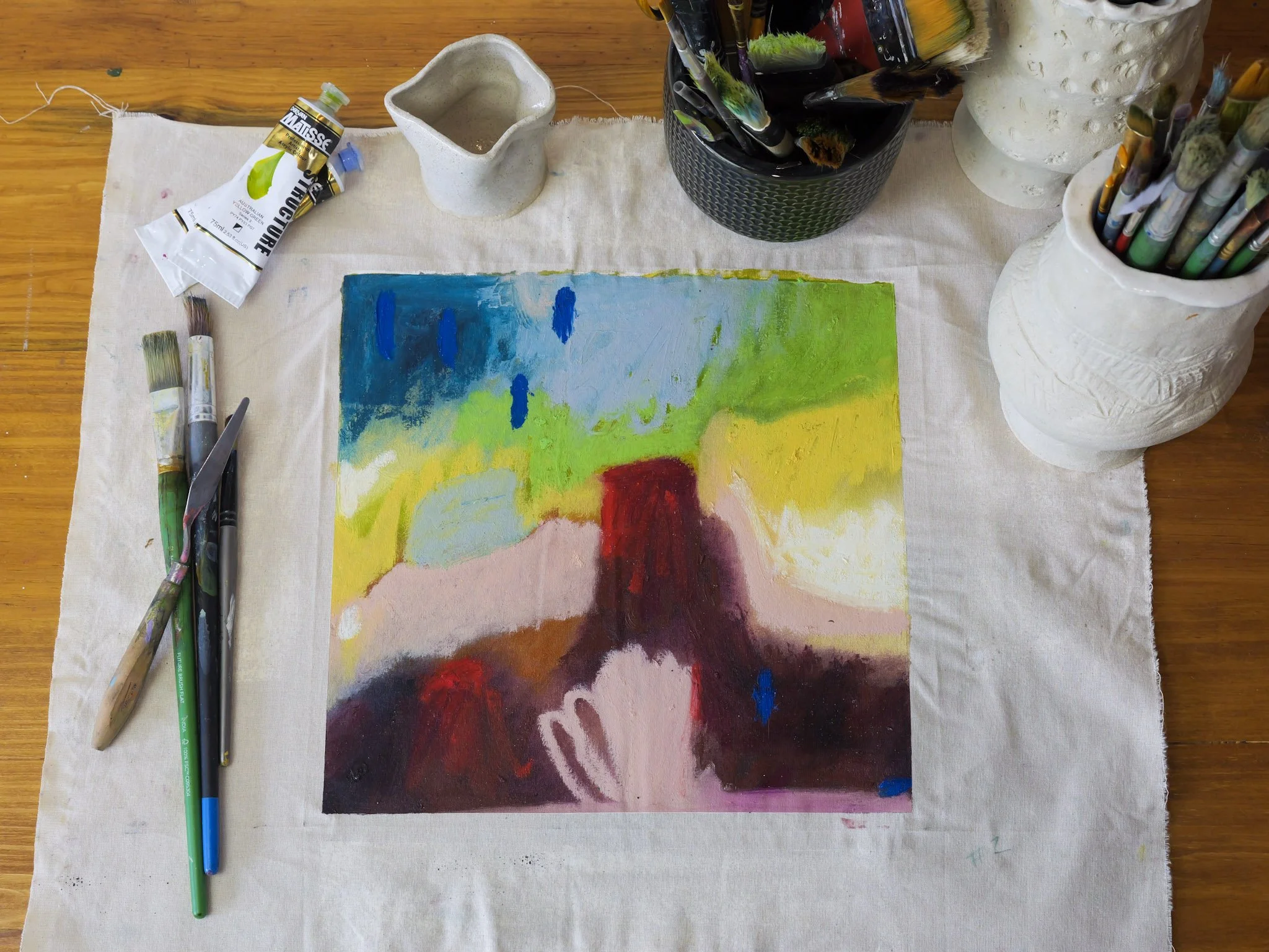
Boundaries Spark Creativity
It All Begins Here
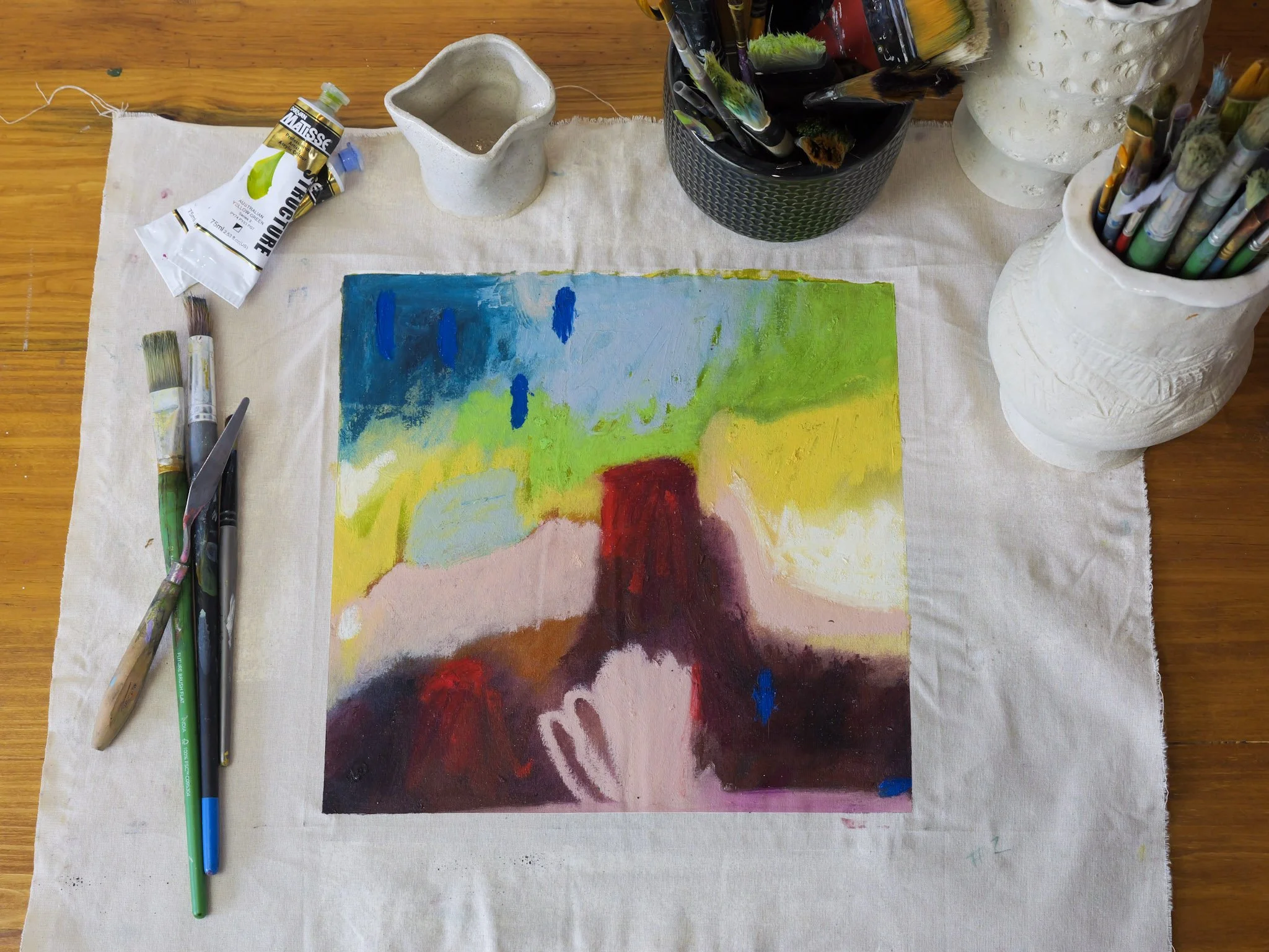
Day 2 30-Day Art Challenge October 2025 (Marie-Louise Bahnson)
Working within daily limits - time, materials, energy - pushes you to simplify, make bold choices, and stop overthinking.
It’s easy to believe that creativity thrives on endless freedom.
More time. More materials. More options. More space to explore every possible direction. But in practice, unlimited choice often leads to hesitation, overthinking, and stalled momentum.
Boundaries don’t restrict creativity — they focus it.
Working Within Limits
Daily limits are unavoidable. Time runs out. Energy fluctuates. Materials are finite. Rather than fighting these constraints, creative practice becomes more productive when you work with them.
When time is limited, decisions matter. You’re less likely to hesitate over minor details and more likely to commit. When materials are constrained, you’re forced to simplify, to ask what’s essential rather than what’s possible. And when energy is low, intuition often steps in where analysis would only slow you down.
Limits strip the work back to its core.
Bold Choices Emerge
Boundaries encourage clarity.
With fewer options available, choices become bolder. You stop layering ideas in search of the “perfect” solution and start trusting the first honest response. The work gains strength through decisiveness rather than accumulation.
This is where confidence begins to build, not through having every resource at your disposal, but through learning how to respond creatively within what’s already there.
Less Thinking, More Making
Overthinking thrives in open-endedness.
When the parameters are clear, the mind settles. You’re no longer asking what else could this be? but instead what can I do with this right now? That shift moves the focus from speculation to action.
Boundaries create momentum. They invite play within a frame, allowing experimentation without overwhelm. The work becomes more physical, more immediate, more alive.
Energy as a Creative Tool
Not every day brings the same capacity, and that’s not a flaw.
Some days call for intensity. Others require restraint. Working within your available energy teaches you to listen rather than push. It encourages efficiency, presence, and honesty in the work you make.
Creativity doesn’t demand exhaustion. Often, it responds better to intention than force.
Freedom Inside the Frame
Paradoxically, structure creates freedom.
When the boundaries are clear, the pressure to perform dissolves. You’re free to explore deeply instead of widely. Free to take risks without needing to justify them. Free to trust that what you’re making is enough for today.
Creativity isn’t about having no limits, it’s about discovering what becomes possible when you accept them.
So set the frame. Honour your time. Use what’s in front of you.
Within those edges, something sharper and more honest can emerge.